

AI weather models have gone from research projects to demonstrated results in roughly three years. Amperon has been tracking that evolution closely, and we've reached a clear conclusion about what it means for energy forecasting.
We are announcing today that we have integrated ECMWF’s AI weather model, AIFS, into our forecasting pipeline alongside the numerical weather prediction (NWP) systems we already run in production. The case for doing this, and the case for doing it carefully, both rest on the same underlying logic.
Weather is not one input among many in power market forecasting. A degree of temperature error translates directly into forecast error for load, price, or renewable generation. Advances in weather modeling have direct commercial consequences for power traders, load-serving entities, and renewable asset owners.
But they cannot rely on AI weather prediction alone.
The evolution of weather forecasting
For four decades, weather forecasting has been built on numerical weather prediction. The idea is straightforward: divide the atmosphere into a three-dimensional grid, then solve the physics equations governing how air, heat, and moisture move forward in time at every point. Feed in observations from a global sensor network (ground stations, radar, radiosondes, ships, aircraft, and since the late 1990s, satellites) and let the math run.
The institution that does this best is the European Centre for Medium-Range Weather Forecasts (ECMWF). Their IFS model is the global standard. Their ERA5 reanalysis, a blended reconstruction of past atmospheric states going back to the 1940s, is the closest thing the field has to a consensus history of the weather.
NWP has improved steadily, adding roughly one day of incremental forecast skill per decade, with resolution tightening from 100km grids in the 1980s to about 10km operationally today. That progress came from national weather agencies running supercomputers. It was slow, expensive, and institutional.
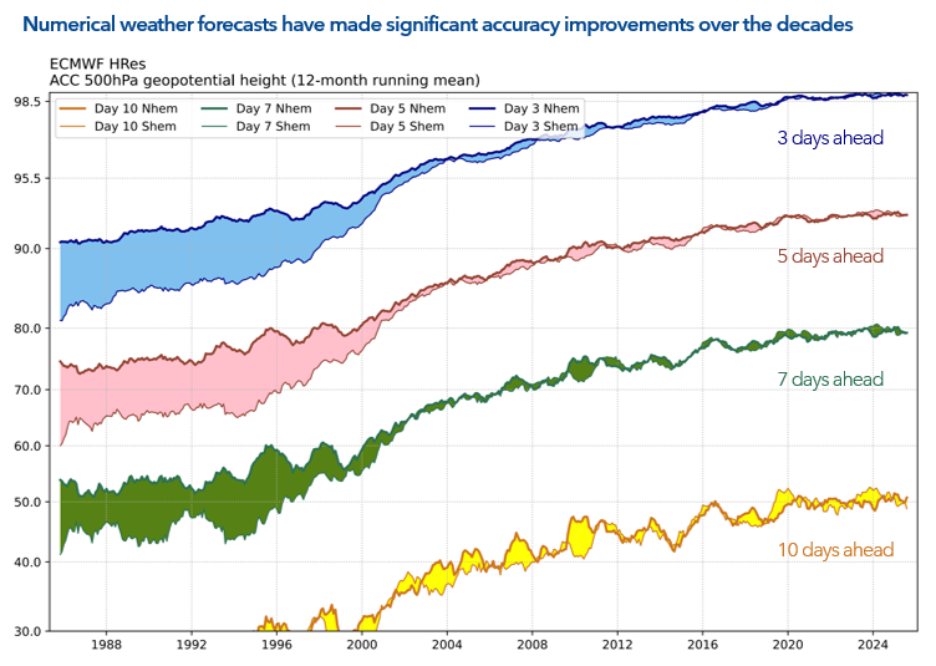
The AI wave started when major technology companies recognized that ERA5 was freely accessible and represented exactly the kind of large-scale structured dataset that modern machine learning was built to exploit. NVIDIA released the first AI weather model in 2022. Google DeepMind's GraphCast followed and became the reference architecture. ECMWF launched AIFS, their own AI counterpart to IFS, in 2024.
By 2025, the leading models were in operational use, and the benchmarks had become genuinely impressive: the best AI models have matched or exceeded NWP on standard accuracy metrics, compressing what would have taken roughly seven years of traditional progress into two. At inference, AI weather forecasts run in minutes on a single GPU or TPU rather than hours on high-performance computing clusters, roughly 100 times cheaper.

The asterisk on AI weather prediction that doesn't get enough attention
The performance gains are real, but the narrative that AI simply replaces numerical forecasting misreads how the two relate. Every AI weather model in production today is trained on ERA5, which is itself a product of numerical models running at ECMWF.
The cheap inference cost of AI weather sits on top of the expensive, multi-year, agency-funded reanalysis infrastructure that produces the training data. AI weather isn't independent of numerical weather; it's built on it, and most models still require numerical output as an initial condition to run at all.
There's a related ceiling that matters for accuracy. ERA5 carries a roughly two-degree temperature gap from raw observations in many regions. That gap doesn't get corrected by a better neural network architecture. It has to be addressed upstream, by training on satellite and station observations directly rather than on reanalysis. Until that problem is solved, all current AI weather models share the same upper bound on accuracy, regardless of how their benchmarks compare to each other.
Both of these points inform how we approached the integration decision.
How Amperon approached AI weather integration
The framing that has dominated coverage of AI weather—AI versus numerical, one architecture versus another—is the wrong framing for a production forecasting platform. The question we care about is how to build an ensemble that captures the most signal from the most independent sources.
That logic already governs how we use numerical weather. We ingest all 51 members of ECMWF's ensemble because more independent signals, blended well, outperform any single source. The same principle extends to AI weather. What AI models offer is not a superior replacement for NWP but a genuinely new input class—one that captures different patterns from the same underlying atmospheric system.
The case for hybrid modeling is strongest in the conditions energy markets care about most. Numerical models still outperform AI on extreme weather events, and extreme events are where load spikes, price dislocations, and reliability emergencies happen.
The Arctic blasts that hit PJM, ISONE, NYISO, and ERCOT, or the prolonged heat waves that stress the same systems in summer, are the types of events that move real money, and they are where the accuracy profile of AI weather is least favorable. A forecasting platform that had fully migrated to AI weather would be most exposed precisely when its customers most need accuracy.
Why Amperon chose ECMWF AIFS
After evaluating the available landscape, we selected an AI weather source that complements and fits cleanly into our existing pipeline.
ECMWF AIFS is the AI counterpart to IFS, already at the core of our energy forecasting suite. It trains on the same ERA5 data that ECMWF produces, from the same institution with the same data standards. It gives us two ECMWF-sourced forecasts running in parallel—one physics-based, one AI-based—with a straightforward integration path alongside our existing ECMWF ingestion.
Paired with IFS and the full ECMWF ensemble, AIFS expands the diversity of our weather input layer feeding every load, generation, and price forecast we produce.
What changes for customers
No changes are required on the customer’s part. Every Amperon forecast now draws on a broader and more diverse weather input layer than it did before.
The field is moving quickly, and we expect the role of AI weather in operational forecasting to continue to evolve. What won't change is the standard we apply when evaluating what to integrate and when: does it add independent signal, does it hold up in the conditions that matter most, and does it fit into an ensemble framework that is honest about the limits of any single source.
Want to understand what Amperon's hybrid weather approach means for your load, generation, or price forecasts? Book a demo and talk to our team.

.svg)



































%20(3).png)
%20(2).png)
%20(1).png)






.png)


.avif)


.avif)
.avif)

.avif)
.avif)
%20(15).avif)

.avif)


.avif)

.avif)
.avif)



