

Solar and wind operators never know exactly how much power they will be able to produce—but thanks to the advent of probabilistic asset forecasting, they can visualize and quantify their risk.
Traditional forecasts tell operators how much power they are most likely to produce, given weather conditions and asset parameters. This information is invaluable, yet it fails to capture the full picture.
How Probabilistic Forecasting Changes Asset Optimization
Probabilistic solar forecasting changes the game by providing a range of possible outcomes and their associated likelihoods. Instead of a single number, users get a distribution curve that helps answer critical questions like:
- How confident can I be in my expected generation target?
- How likely is an extreme scenario, and what time periods are most at risk?
- By how much could I miss, and what would the impact be?
This shift from a point forecast to a probability distribution helps renewable energy operators align decisions with their unique risk profiles. Whether you’re bidding into wholesale markets, managing a complex supply stack, or balancing generation with retail obligations, probabilistic forecasting provides data continuously calibrated to real-world outcomes, helping users act with confidence.
How Probabilistic Forecasting Helps IPPs Maximize Profits
Wholesale energy markets reward precision, and solar and wind operators face unique pressures thanks to inherent variability. Overcommit and you pay imbalance penalties; undercommit and you leave money on the table. Traditional deterministic forecasts don’t provide the confidence needed for aggressive yet risk-aware bidding.
Consider an IPP bidding into the day-ahead market. With deterministic forecasts, they might have bid 80 MW of solar generation based on expected output for the hour ending at 3pm. However, with a probabilistic forecast, they can see there’s a 40% chance that a fast-moving storm front will cause output to drop below 70 MW. They adjust their bid to 65 MW to help insulate their position against potential penalties.
Probabilistic solar and wind forecasting helps IPPs:
- Understand the real-world probability of weather-related generation risks.
- Quantify the likelihood of under- or over-performance.
- Visualize the probability distribution of generation outcomes and bid accordingly
For IPPs, this means smarter bidding strategies in day-ahead and real-time markets. Whether you’re hedging against volatility or capitalizing on favorable conditions, you can act on data, not gut feels.
How Probabilistic Forecasting Helps Utilities Manage Load Risk
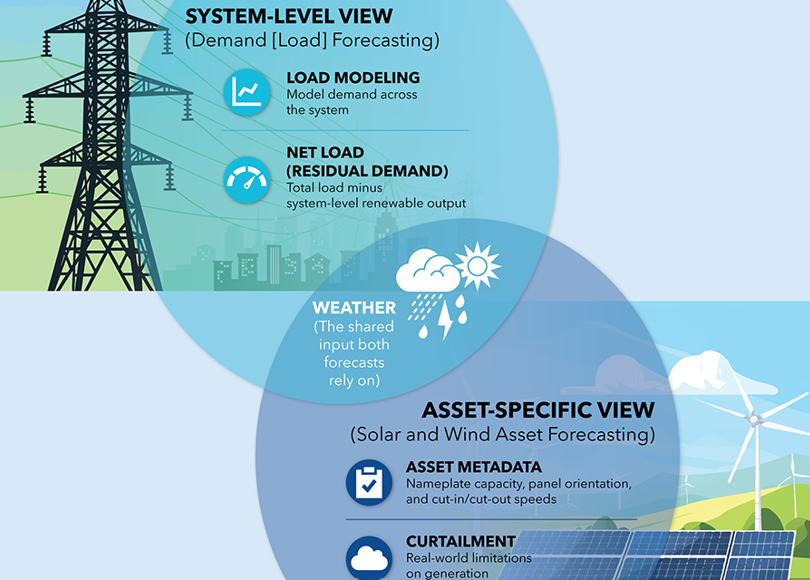
For utilities and gentailers, the challenge extends beyond generation risk to load risk management. Knowing how much power solar and wind will contribute to your supply stack—and how certain that contribution is—helps optimize procurement strategies and maintain reliability.
Consider a large utility managing net load. They operate 600 MW of wind assets at nameplate capacity but anticipate only 300 MW of generation during the evening demand peak. Their Amperon probabilistic forecast also shows a 20% chance of dropping below 250 MW. Armed with this risk awareness, they secure additional generation from a nearby IPP at a fair rate well in advance, avoiding costly real-time market purchases.
Probabilistic solar and wind forecasting helps utilities:
- Predict net load with confidence by factoring in uncertainty.
- Secure backup generation only when probabilities justify it.
- Reduce exposure to imbalance penalties and maintain grid stability.
For utilities, this means better supply planning and reduced exposure to imbalance penalties. For gentailers, it means improved portfolio optimization and customer satisfaction.
Key Features of Probabilistic Solar and Wind Forecasts
Amperon’s probabilistic solar and wind asset Short-Term Forecasts provide:
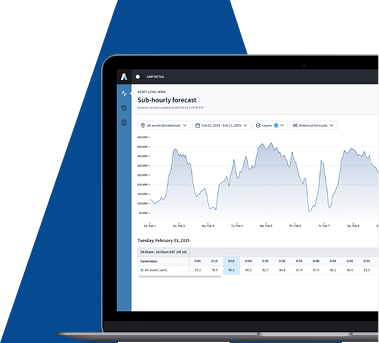
- Sub-hourly granularity: 15-day forecasts can be provided in increments as small as 5 minutes, giving operators detailed visibility.
- Global availability: Designed to meet diverse market requirements for IPPs, including regions like Chile where hourly probabilistic reporting is mandatory.
- A wide range of quantiles: Probability levels P5, P10, P15, P20, P25, P30, P35, P40, P45, P50, P55, P60, P65, P70, P75, P80, P85, P90, and P95 help users calculate probability-weighted expected values and quantify tail risks.
- Integration-ready delivery: Delivered through a REST API for seamless incorporation into existing workflows.
Solar and wind operators never know exactly how much power they will produce, but with probabilistic forecasting, they can quantify their risk. Probabilistic methods transform uncertainty into risk-informed market positions and hedging strategies, improving asset profitability and enhancing grid reliability.
For utilities, this means better supply planning and reduced exposure to imbalance penalties. For gentailers, it means improved portfolio optimization and customer satisfaction.
Explore Amperon’s Asset Management and Optimization solutions.

.svg)








































%20(3).png)
%20(2).png)
%20(1).png)





.png)


.avif)




.avif)
.avif)

.avif)

.avif)
%20(15).avif)
.avif)


.avif)

.avif)



