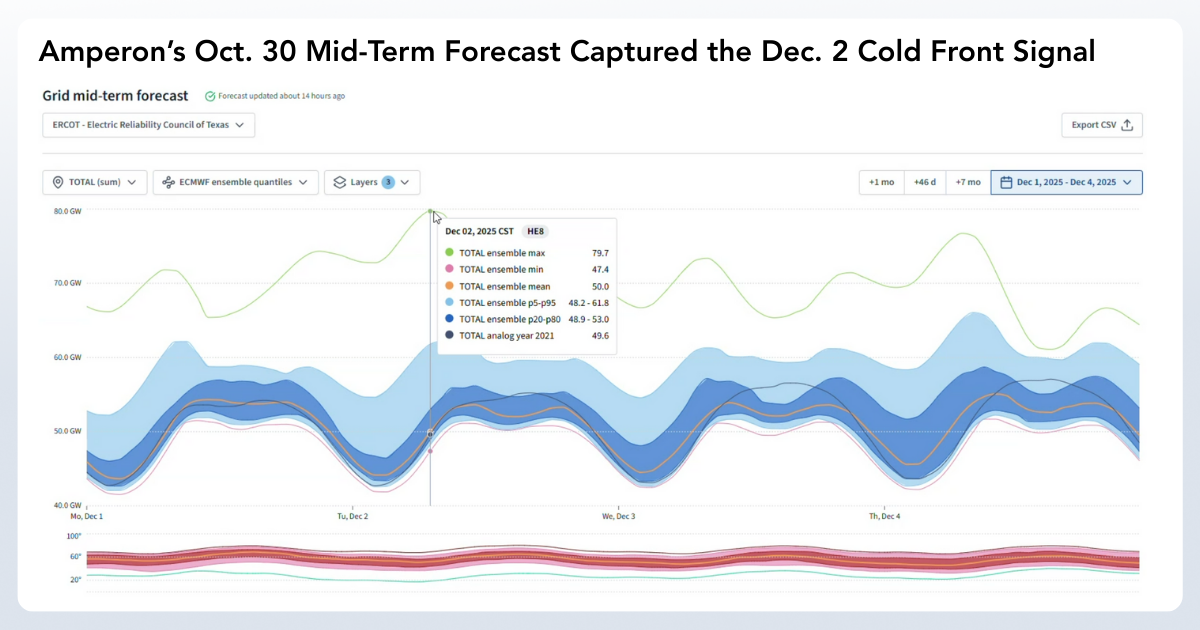
Just before Halloween, Amperon’s new grid-demand Mid-Term Forecast signaled an unusual pattern. Although its median grid demand forecast remained steady, its high-side prediction hinted at a more menacing possibility on the horizon.
The model indicated Texas’ grid could reach a peak demand of 61.8 GW on December 2—over 20% higher than the roughly 50 GW system baseline for early December. Normally, many traders would ignore this type of improbable outcome, especially when trying to interpret weather models more than a month out.
33 days later, the December 2 peak reached 62.2 GW. “Tail risk” had reared its ugly head.
Tail Risk Matters
Tail risk is the idea that improbable events can occur. In power markets, if traders and risk managers have not hedged accordingly, they could be left exposed to massive costs (or miss out on major opportunities).
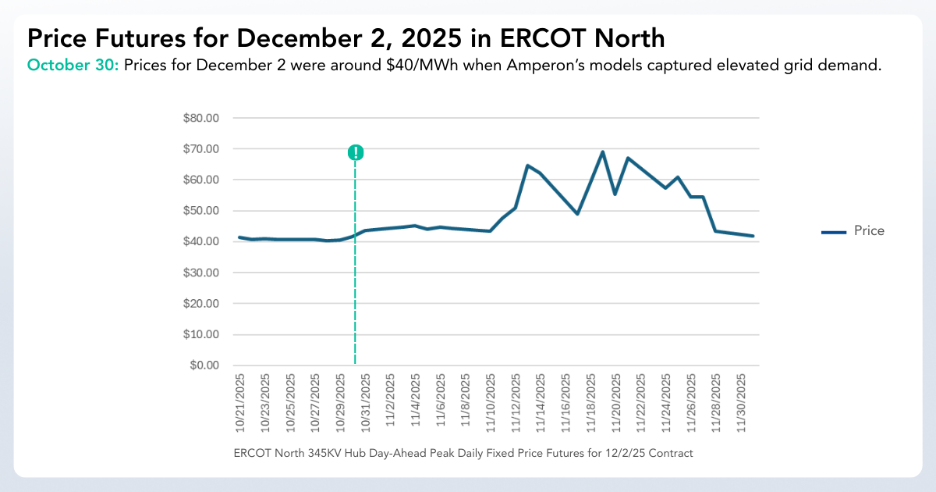
In this case, those who saw the December 2 signal and acted early captured roughly $15-25/MWh in value. For context, average power prices in ERCOT range from $35-40/MWh this time of year, so even a $15 delta represents a 40% change, potentially adding up to millions in avoided exposure—or arbitrage opportunity.
Artificial Intelligence is often described as a major challenge to power systems, but this real example shows the power of AI to improve grid efficiency and operator profitability.
Tracking the Polar Vortex Breakdown
The term “polar vortex” has forced itself into kitchen table conversations in recent years. Many understand it to mean a cold snap. In fact, the polar vortex is a large low-pressure area constantly swirling over the Earth’s poles. It's when the polar vortex breaks down that temperate regions get hit with arctic blasts.
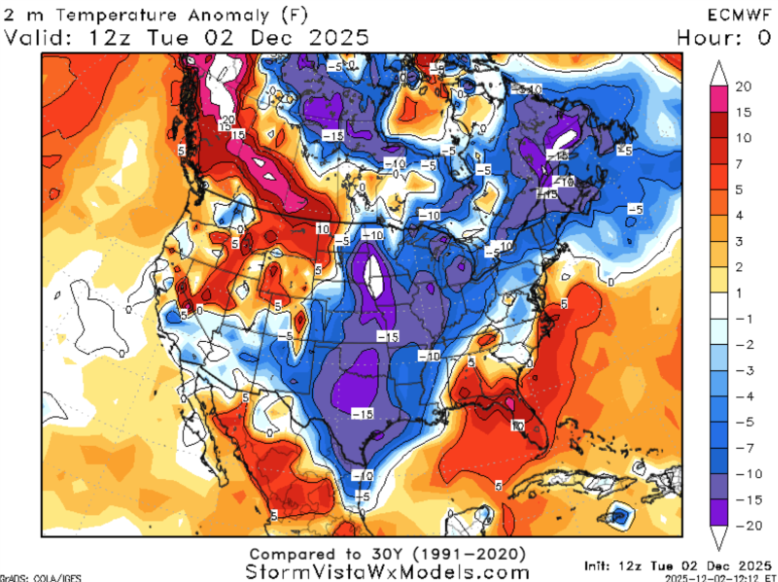
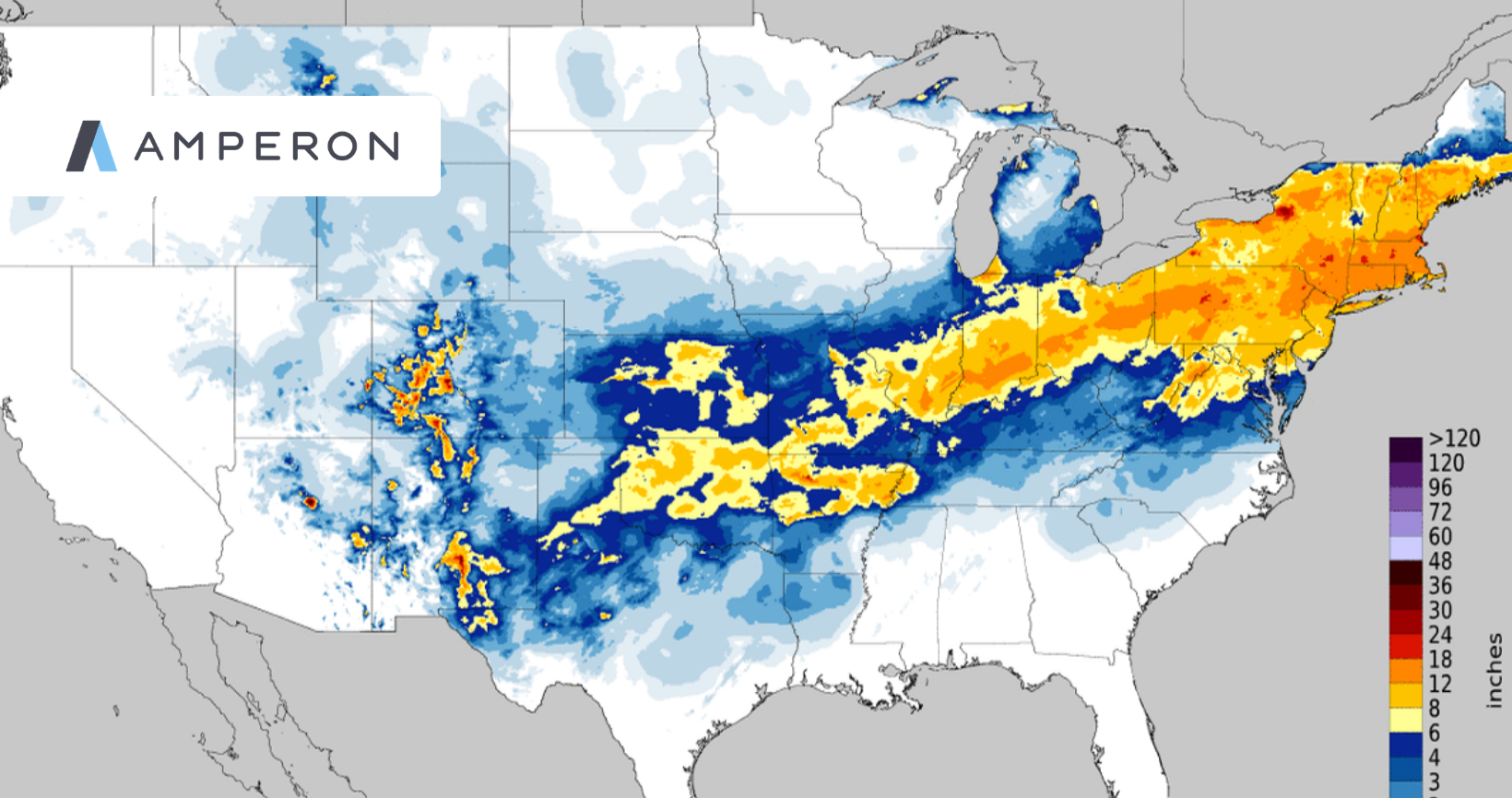
When the northern polar vortex is disrupted, arctic blasts can reach as far south as Texas, as in 2021's infamous Winter Storm Uri. This time, a blast of frigid air surged into parts of Texas and all across the eastern US, triggering freezing temperatures from Dallas to Boston.
Eliminating Mental Math and Gut Calls
Not only did Amperon’s Mid-Term Forecast users receive the storm signal a month out, but they eliminated a time-consuming and historically subjective step: translating weather data into grid demand. Term traders are always watching weather models like the ECMWF, then they traditionally rely on their experience and intuition to extrapolate grid impacts and make “gut calls” on their market positions.
Amperon’s industry-first weather-informed grid-demand MTF dynamically translates 6-hour weather model updates into an hourly grid demand forecast up to 7 months out. Some have been skeptical of this forecast, and to be sure, it is an imperfect science. But advances in both weather models and forecasting methodologies have made it possible to glean important signals from the noise.
This is not the first time Amperon’s MTF signaled surprising events more than a month out. It saw ERCOT’s 2024 MLK Weekend arctic blast 38 days out and PJM’s early-summer heat wave 32 days in advance. In fact, between January 2024 and July 2025, it successfully predicted 67 out of 68 top 1% load events across all PJM, ERCOT, and ISO-NE zones up to four weeks in advance.
Thriving Under Volatility
This early-season arctic blast proves the extremes matter, even though this winter appears mild on average. Tail risk is real—and thanks to recent advances in forecasting methodology, utilities and other market participants can now see a full picture of possible outcomes 30+ days in advance.
Extreme weather events are reshaping power markets, and traditional mid-term forecasts have limited accuracy in the face of changing patterns. And while AI may be adding further complexity by driving formidable new load growth, it’s also saving companies millions by helping them see and plan for a volatile future.
As of December 2, the p95 ensemble in Amperon’s Mid-Term Forecast is signaling another US cooldown the week of Christmas. The time to capture value is now. Contact us to discuss your options.


.svg)










































%20(3).png)
%20(2).png)
%20(1).png)






.png)


.avif)



.avif)
.avif)

.avif)

.avif)
%20(15).avif)
.avif)


.avif)

.avif)