


What is wind power forecasting?
Wind power forecasting predicts how much electricity a specific asset will generate in a given period, enabling asset operators to submit optimal day-ahead and real-time bids and manage wind curtailment risk.
Unlike grid-level net demand forecasts, wind power forecasting software models site-specific conditions such as hub height and hyper-local weather. AI-powered wind asset forecasting continuously adapts to changing weather conditions and rapid output swings.

Wind asset short-term forecast
(Wind STF)
(Wind STF)
Short-term wind generation forecasts for wind assets and portfolios across day-ahead and multi-day horizons. Captures the non-linear relationship between wind speed and power output. Models are trained on each site’s historical generation, physical configuration, historical wind curtailments, and hyper-local weather data to support bidding, scheduling, and portfolio reporting.
7-15%
Target cnMAE

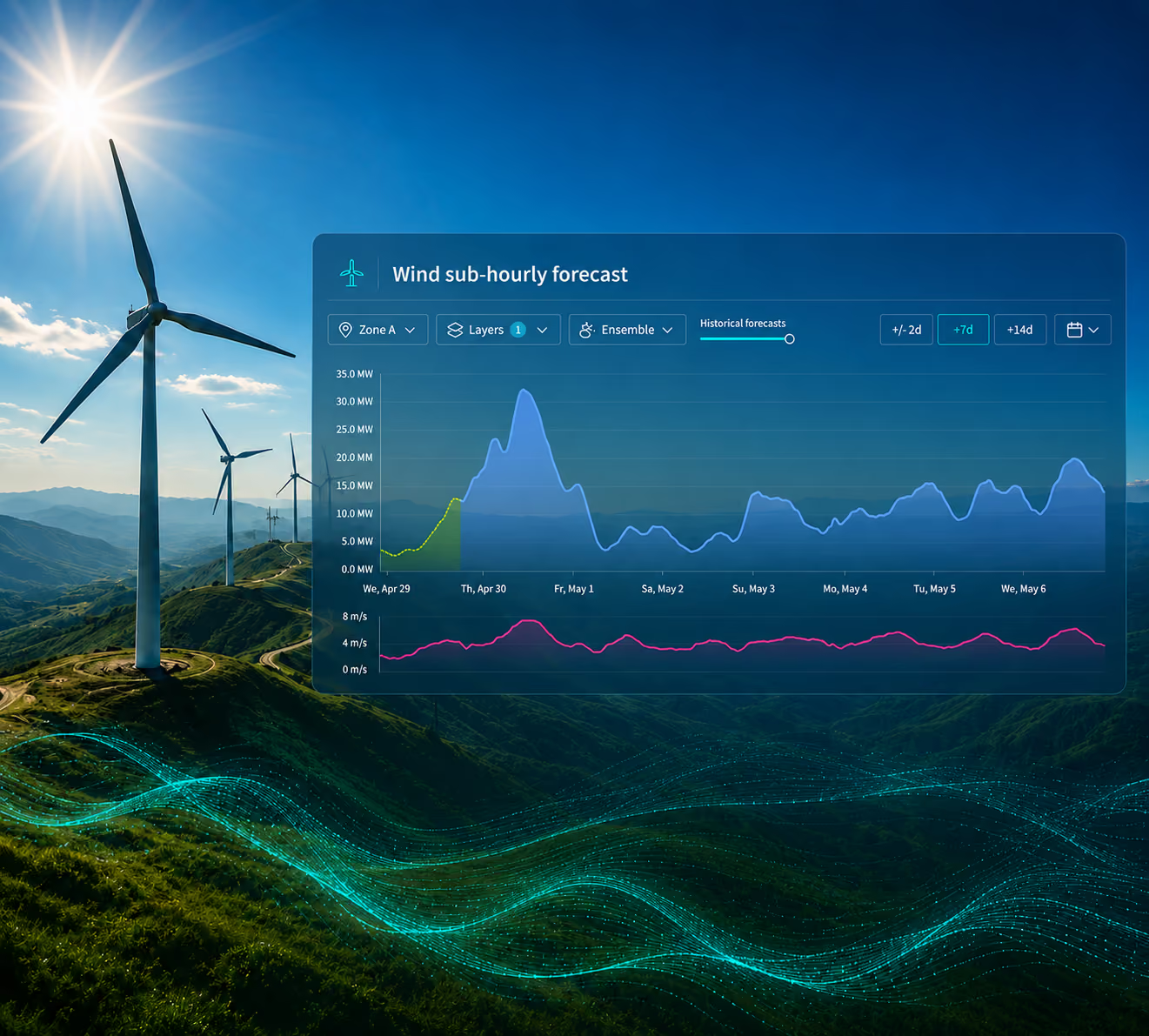
Wind asset sub-hourly short-term forecast
(Wind Sub-hourly STF)
(Wind Sub-hourly STF)
Intra-day wind generation forecasts with sub-hourly resolution for day-ahead bidding, real-time dispatch, and wind curtailment management. Built for wind ramp events: sudden output swings caused by front passages or directional shifts that less granular forecasts miss. Continuously updated using real-time wind speed at hub height data and turbine-level performance to capture rapid output swings as they develop.
5
Minute resolution available
Who uses wind forecasting software?
Wind asset operators at IPPs, utilities, and certain retailers and commercial and industrial operations.

Independent Power Producers
IPPs operating wind farms, including hybrid battery-tied assets.

Utilities and Gentailers
Utilities and energy retailers who also own wind assets.

Commercial & Industrial Customers
Commercial & industrial facilities and data centers with market-exposed wind assets.
7-15%
Target wind forecast cnMAE
60+
Wind assets forecasted
3 Weeks
Average time from contract to wind forecast deployment
1
Data inputs
We identify and collect relevant data streams like coordinates, historical generation, and physical asset attributes.
Hybrid modeling
A blend of physics-based and machine learning models produces our forecasts and updates them hourly as new data arrives.
2
3
Flexible outputs for any workflow
The forecasts integrate seamlessly with Amperon customers’ preferred analytical tools.
Actionable insights
Asset operators make better-informed decisions that improve margins and achieve strategic goals.
4
Wind energy forecasting FAQs
Here are some answers about our platform, implementation process and pricing.
How does Amperon forecast wind generation?

Amperon builds asset-specific wind generation forecast models that combine physics-based representations of each asset's performance characteristics with machine learning trained on historical generation and weather data.
Models retrain hourly on the latest observational inputs, producing sub-hourly forecasts that reflect current atmospheric conditions rather than static assumptions. Probabilistic outputs quantify the range of likely generation outcomes across weather scenarios, giving operators visibility into forecast uncertainty at the time horizons that matter most for bidding and scheduling decisions.
Models retrain hourly on the latest observational inputs, producing sub-hourly forecasts that reflect current atmospheric conditions rather than static assumptions. Probabilistic outputs quantify the range of likely generation outcomes across weather scenarios, giving operators visibility into forecast uncertainty at the time horizons that matter most for bidding and scheduling decisions.
How accurate are Amperon’s wind asset forecasts?
We target 7-15% cnMAE for wind asset forecasts. Actual results vary by site.
For more on the cnMAE accuracy metric, see cnMAE: The Right Metric for Evaluating Solar and Wind Forecasts.
For more on the cnMAE accuracy metric, see cnMAE: The Right Metric for Evaluating Solar and Wind Forecasts.
What is cnMAE and why is it the right metric for evaluating wind power forecasts?
Capacity-normalized Mean Absolute Error, or cnMAE, measures forecast error as a percentage of an asset's installed capacity rather than its actual generation output. This distinction matters because wind generation frequently operates at low output levels, and expressing error as a percentage of actual output during those periods can make forecast performance appear far worse than it functionally is.
cnMAE provides a stable, asset-scale denominator that allows meaningful accuracy comparisons across assets, seasons, and time horizons, making it the most reliable basis for evaluating and benchmarking renewable generation forecast quality. For more on the cnMAE accuracy metric, see cnMAE: The Right Metric for Evaluating Solar and Wind Forecasts.
cnMAE provides a stable, asset-scale denominator that allows meaningful accuracy comparisons across assets, seasons, and time horizons, making it the most reliable basis for evaluating and benchmarking renewable generation forecast quality. For more on the cnMAE accuracy metric, see cnMAE: The Right Metric for Evaluating Solar and Wind Forecasts.
Which weather models does Amperon use for wind generation forecasting?
Amperon’s wind forecasts use a dynamic blend of multiple leading weather models from vendors such as ECMWF, DTN, NWS (US only), and DWD (Europe only). Learn more about Amperon’s approach to weather ensembling here.
How often do Amperon's wind generation models update?
Amperon’s wind asset generation forecasts update hourly, which continuously takes into account changing weather and generation dynamics and helps to capture crucial ramping periods that 6-hour updates miss. Hourly updates refer to model retraining, meaning new sub-hourly output predictions are available every hour.
Can wind energy forecasts predict output during peak times?
Yes, Amperon’s wind forecasts provide predictions at hourly or sub-hourly granularity, up to every 5 minutes, which is more than enough to forecast output during morning and evening load ramps, peak pricing periods, and coincident peak events.
What data do you need to produce a wind generation forecast?
Amperon ingests each site’s coordinates, historical generation data, and asset metadata such as nameplate capacity, power curves, hub height, and historical curtailments. Our team works collaboratively with each client to identify and collect relevant data streams for each wind farm.
How long does it take to deploy a wind forecast?
Amperon works collaboratively with asset operators to identify and collect relevant data streams. If all needed data is readily available, Amperon can stand up wind asset forecasts in a matter of days. Typically, it takes a few weeks to collect and integrate data streams and deploy and test a wind forecast.
How does probabilistic wind forecasting work?
Probabilistic wind forecasting takes the guesswork out of renewable energy bidding by quantifying not only the range of possible outcomes, but the associated likelihood of each scenario. This helps asset operators calibrate expectations against real-world probabilities and compare scenarios against each other. For example, a P50 forecast is the median–the actual value is equally likely to come in above or below it–whereas a P90 is a conservative estimate, with the actual expected to land at or below it 90% of the time, making it useful for downside planning. For more, see Quantifying Solar and Wind Uncertainty with Probabilistic Asset Forecasting.


Transform your energy operations with market-leading accuracy and enterprise-grade reliability.
Join our newsletter to stay up to date on features and releases.


© 2025 Amperon™ Holdings, Inc. All Rights Reserved.