A widespread Arctic storm brought subfreezing temperatures, snow, and ice across most of the U.S., pushing power systems into sustained winter stress. While the most severe impacts have passed, freezing conditions continue to linger across much of the East Coast, keeping heaters running and demand elevated even after the initial peak days.
For many market participants, the scale and duration of the cold caught them off guard. As short-term weather models rapidly adjusted, traders were forced to scramble to reprice risk, secure supply, and manage rising demand expectations. Power prices responded quickly, moving sharply higher across PJM, ISONE, NYISO, and ERCOT as the market absorbed the new reality.
But this wasn’t a surprise for those using seasonal forecasts based on real-weather data. Amperon’s Mid-Term Demand Forecast (MTF), now with probabilistic and ensemble modeling, began flagging the risk of extreme cold and elevated peak demand weeks before prices moved, providing traders with early visibility into a setup that would ultimately drive future prices 10x higher.
This is the difference between reacting to volatility—and positioning ahead of it.
PJM: When Demand Risk Was Visible, Prices Were Still Quiet
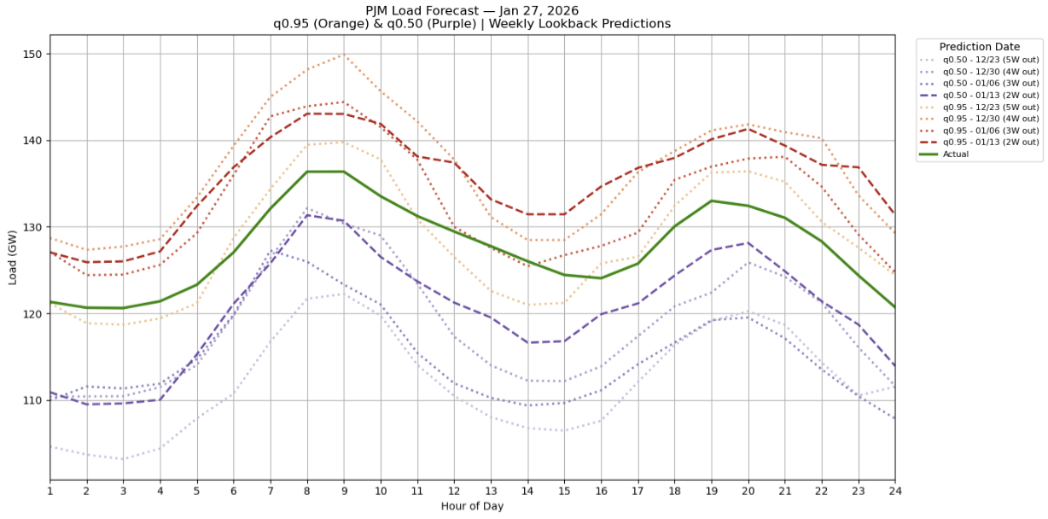
PJM saw the highest demand days on January 29 and 30 at 139.0 and 139.1 GW. This was after January 26 and 27 also brought demand above 136 GW. While day-ahead demand fluctuated the days before, there was signal of the severe cold long before the market reflected it. Here’s a timeline of the signal our MTF picked up.
MTF Signal Timeline
- December 17: One of MTF’s models flagged 139 GW peak demand for January 29.
- December 19–21: The P75 and P80 predicted demand to peak around 139 GW on January 29 and 30 with more ensemble members converging into tighter agreement.
- Christmas week: More ensemble members converged into tighter agreement as PJM Western Hub Day-Ahead Peak Daily Fixed Price Futures were at $82.11 for January 29 and 30.
- January 27: PJM Western Hub Day-Ahead Peak Daily Fixed Future Prices continued to increase to $819.93.
- Delta: That’s 10x higher, or an extra $740/MWh, than when our MTF forecasts started showing signs of the cold weather.
ISONE: A High-Confidence Cold Signal, Weeks Ahead of the Spike
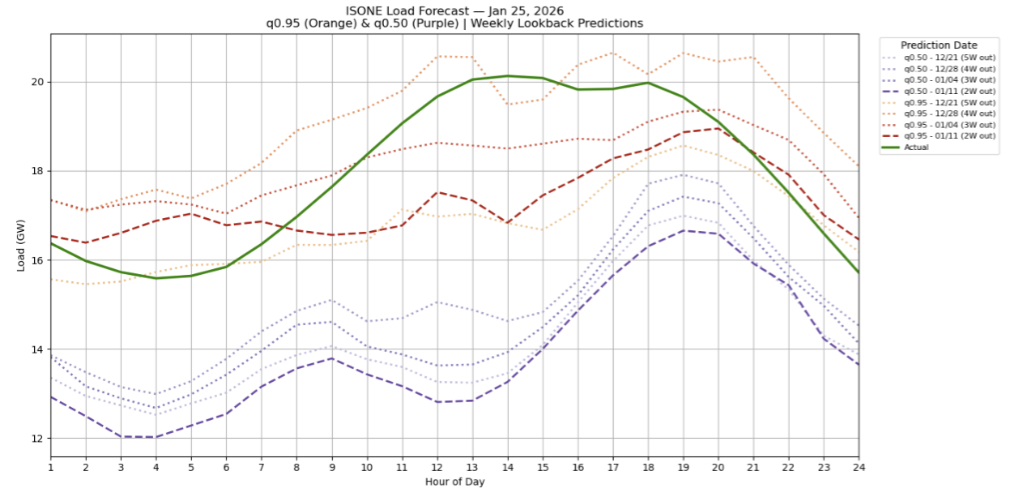
Demand peaked at 20.1 GW on January 25 with continued elevated demand through January 30. But, again, Amperon’s MTF started showing signal well before prices adjusted.
MTF Signal Timeline
- December 16: The MTF ensemble members first flagged ~20.1 GW demand for January 25 when ISONE Massachusetts Hub Peak Futures were around $100 (Jan 25) and $143–$145 (Jan 26–27).
- December 19: The P95 forecast reached 20.1GW for January 25.
- December 23–28: The signal strengthened significantly, with multiple ensemble members and the P95 showing demand peaks around 20.1 GW as futures prices hovered around $112 for January 25 and $146-$152 for January 26-27.
- January 23: ISONE Massachusetts Hub Day-ahead peak futures prices ranged from $315-$345.
- Delta: That’s about $200 more from when our initial MTF forecasts started showing signs of the colder weather for next week.
NYISO: Early Warnings Before Volatility Took Over
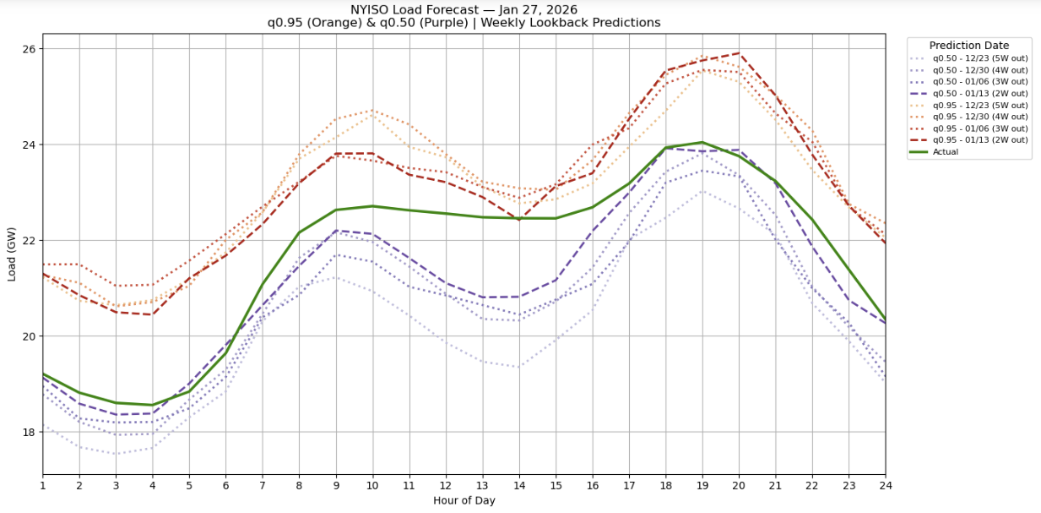
In NYISO, demand surpassed 23 GW on January 25 and 26 with the highest demand peaking at 24.0 GW on January 27 and 24.2 GW on January 30. But Amperon’s MTF was already highlighting upside risk in mid-December.
MTF Signal Timeline
- December 18: The First MTF ensemble models showed ~24 GW peaks for January 30 as Zone J Day-Ahead Peak Daily Fixed Price Futures traded around $116 (Jan 25) and $142 (Jan 26–27 and Jan 30).
- December 21: The P85 forecasted demand to settle around reached 24 GW for January 27 and 30.
- Christmas week: The signal was stronger and much more consistent with the P75-P80 expecting demand on January 27 and 30 to peak above 24 GW as NYISO Zone J Day-Ahead Peak Daily Fixed futures were around $138 (Jan 26–27 and 30).
- January 23: Short-term forecasts showed dramatic day-over-day swings, reflecting how late the market processed the risk. Futures prices ranged from $394–$398 for January 26-27 and 30, almost triple from when our initial MTF forecasts started showing signs of the colder weather for the next week.
- January 29: Futures prices for next day's peak was $420.
- Delta: Prices more than tripled from when our initial MTF forecasts started showing signs of the cold weather.
ERCOT: Early Signal, Explosive Price Reaction
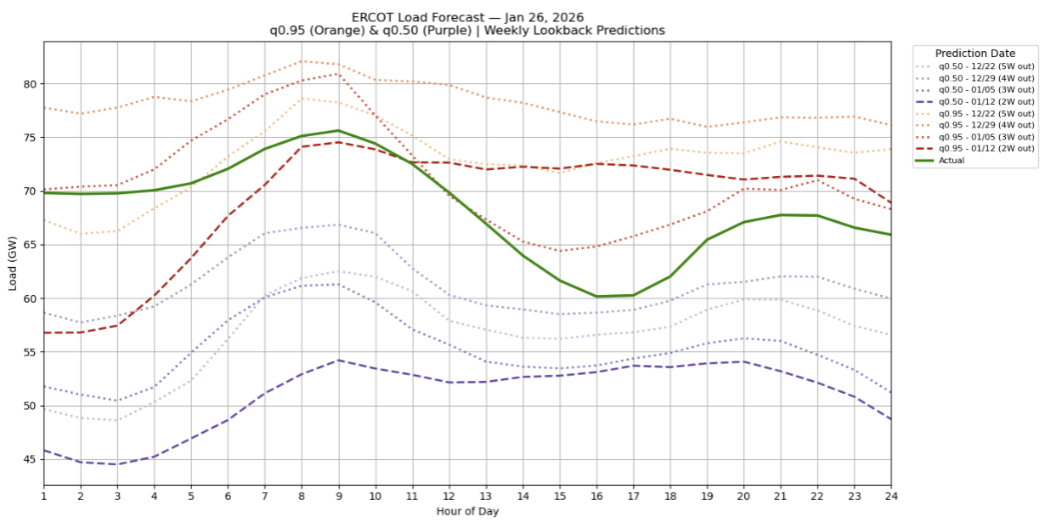
Demand peaked on the morning of January 26 at 75.6 GW after a week of cold weather, but Amperon’s MTF was tracking it the whole way.
MTF Signal Timeline
- December 17: Multiple ensemble members and the P85-P90 showed peak demand around 75 GW on January 26th when prices for ERCOT North 345KV Hub Day-Ahead Fixed Futures were at $55.37.
- Week of Christmas: The signal strengthened and became more consistent with the P85 consistently expecting demand on January 26th to peak around 75.6 GW. Prices were still at $60.22.
- January 23: Prices shot up to $765 as demand surged with Day-Ahead prices for January 25th clearing around $1,660.
- Delta: Prices increased more than 10x from the MTF’s first signal.
Using Mid-and Short-Term Forecasts To Trade The Swings
As much as our MTF showed signals weeks in advance, there was still dramatic swings day over day. While it’s important to know when futures are low to buy, it’s just as important to know when prices are high to exit the position. Day-Ahead Peak Daily Fixed Price Futures for Zone J went from $103, $162-$171 on January 19th to $237–$257 on the 20th. While it’s important to know when futures are low to buy, it’s just as important to know when prices are high to exit the position. Amperon’s Mid-Term and Short-Term Forecasts gives you that insight to trade both sides of the swing.
The Arctic blast underscores how quickly pricing can change once short-term forecasts confirm what mid-term fundamentals have already signaled. By identifying sustained cold risk weeks in advance, Amperon’s Mid-Term Demand Forecast gave traders more time to evaluate peak exposure, structure hedges, and navigate volatility before prices adjusted. In this market, time remains one of the most valuable inputs.

.svg)









































%20(3).png)
%20(2).png)
%20(1).png)






.png)


.avif)




.avif)
.avif)

.avif)

.avif)
%20(15).avif)
.avif)


.avif)

.avif)
.avif)