

Most demand forecasting platforms assume a simple truth: the load measured at the meter is the load you need to forecast. That works when the meter is just measuring a building. It stops working the moment behind-the-meter resources enter the picture.
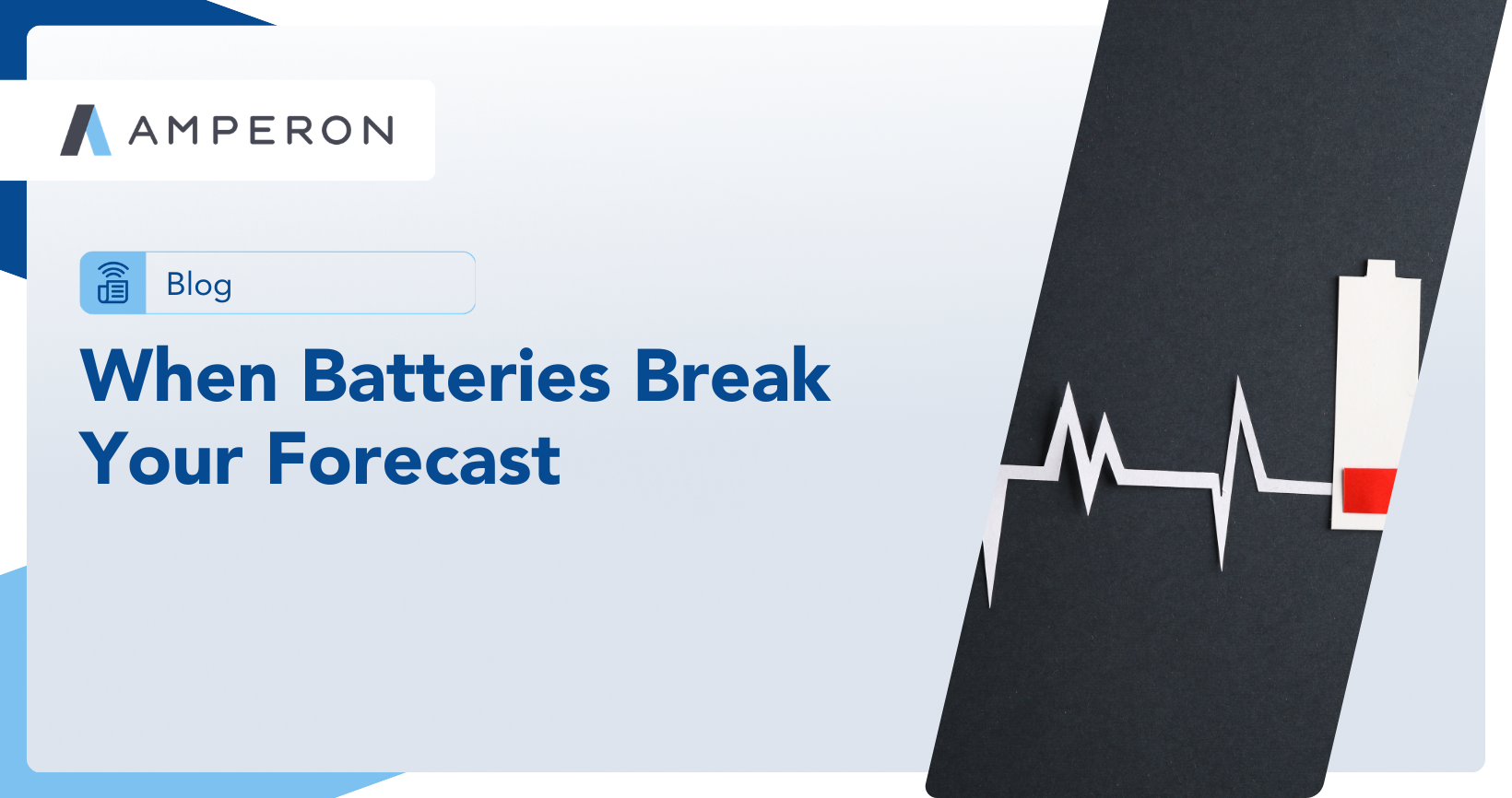
When a battery charges, metered load spikes dramatically. When the battery discharges, metered load craters. A building consuming 200 kW at peak might register 400 kW during a charge event, or near-zero during discharge.
This can result in erratic forecast peaks that don’t correspond to real consumption—models that are technically correct but commercially unusable.
An Energy Retailer Faced Mounting Battery-Driven Forecast Noise
This battery noise was becoming a major problem for a clean energy retailer operating in ERCOT. They have a growing number of C&I customers using behind-the-meter batteries, which charge and discharge in response to market conditions and demand response events—exactly as designed.
But those same actions were quietly undermining the retailer’s forecasting workflow. On the trading desk, short-term forecasts were swinging sharply during intervals where neither weather nor underlying load patterns had changed. Forecast shapes stopped making sense, limiting traders’ ability to manage positions confidently.
On the procurement side, long-term forecasts began embedding battery artifacts into peak projections, inflating expected demand and driving hedges against load that wasn’t real. The team spent increasing amounts of time investigating anomalies rather than acting on forecasts.
The team spent increasing amounts of time investigating anomalies rather than acting on forecasts.
How to Forecast Load With Behind-the-Meter Batteries
Instead of trying to forecast the meter “as-is,” the retailer recognized that meter data was now a composite signal—part building load, part battery activity. To produce a forecast that supports real commercial decisions, those components need to be treated separately.
Amperon’s platform is designed for exactly this kind of complexity. Rather than forcing all activity into a single data stream, it can ingest and model distinct data layers independently.
For this retailer, meter actuals continued to flow into Amperon through standard integrations. Battery charging and discharging data, however, was ingested as a separate telemetry stream directly from the customer’s systems. Amperon netted battery behavior out of the metered load, isolating the clean building demand underneath. That net demand signal became the foundation for both short-term and long-term forecasts.
Once battery distortion was removed, forecast volatility dropped, accuracy improved, and internal teams saved hours of debugging each week. What had been a blocking issue for both trading and procurement effectively disappeared.
Battery charging and discharging data was ingested as a separate telemetry stream directly from the customer’s systems.
Why All Behind-the-Meter Resources Create Similar Forecasting Issues
Behind-the-meter batteries are only one example of a broader trend reshaping load forecasting. As distributed energy resources continue to scale—solar, storage, managed EV charging, and virtual power plant (VPP) participation—the meter increasingly represents a stack of interacting assets rather than a single consumption signal.
Behind-the-meter batteries are only one example of a broader trend reshaping load forecasting.
If multiple behind-the-meter resources are at play, mental math quickly becomes unmanageable. Data streams must be ingested separately, then combined and normalized in a way that allows for easy disaggregation.
Amperon’s Flexible Data Interface is built to handle this reality by treating demand, generation, and storage as distinct but connected layers. Data can be ingested from ISOs, EDI providers, third parties, or directly from customers. All of this can then be normalized into a single, decision-ready forecasting foundation.
Explore Retail Performance Management Solutions

.svg)






































%20(3).png)
%20(2).png)
%20(1).png)





.png)


.avif)



.avif)
.avif)

.avif)
.avif)
%20(15).avif)

.avif)


.avif)

.avif)
.avif)



