Product Launch
New Product Alert! Grid Mid-Term Forecast Expands to Europe
Learn More

Why Data Centers are Moving Beyond Renewable Energy PPAs

Power Purchase Agreements guarantee prices, not delivery—and that distinction is becoming a major liability for data centers and their power suppliers.

Cameron Odegaard
April 8, 2026
April 8, 2026

Summary

1
Technology companies, historically the leading solar and wind buyers, are exploring new strategies to secure firm power.
2
As their footprint grows, hyperscalers are signaling intent to participate in wholesale power markets.
3
Power traders will need to anticipate GW-scale fluctuations in net load resulting from data center activity.
4

Something fundamental has shifted in American power markets, and it happened faster than almost anyone predicted. Since ChatGPT launched in November 2022, spending on data centers in the US has exploded from $13.8 billion to $41.2 billion per year — a 200% increase in just three years, at a time when virtually all other construction activity in the country has slowed.

The scale of what's coming is staggering. Rystad Energy estimates the US has over 100 GW of data center demand coming online between 2024 and 2035. Global data centers already consume power at a rate roughly equivalent to the entire annual electricity consumption of France, and under the most likely growth scenario, that number doubles to around 945 TWh by 2030. Under an accelerated AI adoption scenario, it could hit 1,700 TWh by 2035, placing the sector on par with the energy footprint of India.

Grid planners are scrambling to keep up. Of the 166 GW in forecast peak load growth across the US through the end of the decade, roughly 90 GW, well over 50%, is tied to data centers alone. Utilities are receiving interconnection requests that in some cases more than double their existing peak loads. And the supply side isn't keeping pace. In fact, over 83 GW of dispatchable baseload generation is slated for retirement over the next decade, tightening an already stressed equation. The digital economy is running headlong into the limits of the physical grid.

Utilities are receiving interconnection requests that in some cases more than double their existing peak loads.
How Hyperscalers Are Chasing Power

For the hyperscalers building this infrastructure, power isn't just an operating cost — it's the binding constraint on how fast they can grow. And the money they're willing to spend to solve it reflects that.

The Big Five hyperscalers (Amazon, Microsoft, Google, Meta, and Oracle) are projected to spend over $600 billion on infrastructure in 2026 alone, a 36% increase from 2025. Roughly 75% of that targets AI infrastructure directly. Capital intensity has reached over 50% of revenue for some companies — numbers that historically look more like a regulated utility than a technology business. Goldman Sachs projects the Big 5 will spend $1.15 trillion in total CapEx between 2025 and 2027. Maintaining this pace risks profitability if AI adoption lags, but pulling back means losing the race — so the spending continues.

The scale of individual projects makes the aggregate numbers concrete. When Mark Zuckerberg visited the White House, he showed Trump a proposed data center footprint overlaid on a map of Manhattan — miles long, miles wide, covering most of the island. Meta's Hyperion campus in rural Louisiana spans 2,250 acres of former farmland, carries a reported $50 billion price tag, and is designed to scale to 5 GW over several years.  

Prometheus, Meta's first gigawatt-scale cluster, comes online in 2026 and will be the largest data center in the world when complete. Meta's capital expenditure guidance for 2025 sits at $72 billion — up 70% year-over-year — with Zuckerberg warning that 2026 spending will be "notably larger." In response, the Trump administration authorized AI companies to operate as their own private utilities, effectively clearing the way for hyperscalers to build and manage on-site generation independent of the traditional utility framework.

The Trump administration authorized AI companies to operate as their own private utilities, effectively clearing the way for hyperscalers to build and manage on-site generation.

At these capital levels, the cost of power becomes a secondary concern. What matters is availability, reliability, and speed of access. That calculus is reshaping how these companies procure energy.

PPAs: The Default Data Center Power Procurement Tool, and Its Limits

The Power Purchase Agreement became the dominant procurement mechanism for hyperscalers over the past decade, and the numbers reflect that clearly. In 2024, a record 68 GW of corporate clean energy PPAs were announced globally. Data centers drove nearly 60% of US corporate PPA volume that year, up from around 50% the prior year. Microsoft alone has contracted 34.7 GW of clean power — making it the largest corporate clean energy buyer in the world.

Indeed, technology companies have been the predominant PPA buyer over the last decade or more, ushering in an era of unending growth for renewable energy. A PPA's appeal is straightforward: it locks in a long-term price for electricity, typically 15–20 years, giving hyperscalers cost certainty, plus the renewable energy certificates needed to support net-zero commitments.  

But PPAs have a structural flaw. The majority are tied to solar and wind assets, which are intermittent by nature. A PPA locks in a price — not a delivery guarantee. When a contracted solar project curtails because the grid is congested, the data center still owes the payment but receives no electrons. That mismatch is becoming harder to ignore as curtailment accelerates across US grids. In 2024, four of the seven US ISOs set annual records for curtailed renewable energy. In ERCOT alone, over 8 TWh of wind and solar was curtailed that year. Even PJM, historically a low-curtailment region, saw curtailments jump roughly sixfold.

When a contracted solar project curtails because the grid is congested, the data center still owes the payment but receives no electrons.

This is partly the hyperscalers' own doing. The same data center load growth pushing PPA signings to record levels is accelerating grid congestion — increasing the curtailment risk on the very contracts being signed. Transmission is the silent bottleneck: generation exists, but it can't always reach where it's needed.

The industry is adapting. Hybrid contracting — solar paired with battery storage — is growing fast, with 2 GW contracted in North America in 2024. And 56% of developers are now exploring co-located or on-site generation as a core strategy, not a fallback. But renewable energy and batteries are not enough to fill the need.

The Nuclear Option: When Price Stops Being the Barrier to Power Procurement

No moment better illustrates how hyperscalers think about power than the resurrection of Three Mile Island, the infamous nuclear power plant in Pennsylvania. Unit 1 at Three Mile Island operated safely for decades before being shut down in 2019. In the end, it wasn't a safety issue — it was an economic one. Cheap natural gas and subsidized renewables had made the plant uncompetitive, and Pennsylvania lawmakers declined to intervene. The reactor went dark.

Five years later, Constellation Energy announced it would restart the plant under a 20-year Power Purchase Agreement with Microsoft. Microsoft will purchase the plant's entire generating output — 835 MW — enough to power roughly 800,000 homes. Restarting requires significant investment in the turbine, generator, main power transformer, and cooling and control systems. MIT nuclear engineering professor Jacopo Buongiorno estimated the restart cost will run into the tens of billions. Microsoft will likely pay above-market rates for the power.

Microsoft will likely pay above-market rates for the power.

Three Mile Island is not a one-off. An AWS-Susquehanna deal further illustrates both the appetite for nuclear power and the regulatory complexity that comes with it. The companies signed a new 1,920 MW PPA running through 2042. Talen expects the contract to generate roughly $18 billion in revenue over its life. Meanwhile, Meta has issued an RFP for 1.4 GW of new nuclear capacity, and Google has signed agreements with small modular reactor developers.

The regulatory picture is still evolving. PJM's market monitor has warned that diverting existing nuclear output to serve data centers directly could have significant effects on wholesale energy and capacity markets — a concern that will only grow as more deals of this scale get structured.  

But nuclear's appeal is simple: it produces carbon-free power around the clock, perfectly matching the load profile of a server farm in a way that wind and solar cannot. The question is no longer whether hyperscalers will pursue nuclear — it's whether the regulatory framework can keep up with the pace at which they're doing it.

Nuclear's appeal is simple: it produces carbon-free power around the clock, perfectly matching the load profile of a server farm in a way that wind and solar cannot.
Data Center Load Profiles: Why They’re Different

Understanding why hyperscalers are willing to pay a premium for firm power requires understanding what their load actually looks like. Data centers are high load factor, near-baseload consumers. Dominion Virginia reported an 82% load factor for large data centers, and Duke Energy plans for new large loads at 80%. Unlike most industrial or commercial loads, there's no meaningful morning ramp, no evening peak, no weekday-weekend variation. The servers run continuously at roughly the same level around the clock.

This is particularly true for AI training workloads, which have an especially flat consumption pattern. AI inference — running models for end users — introduces more variation, but the overall shape stays close to baseload. Data centers typically maintain utilization rates around 80%, leaving roughly 20% headroom that can theoretically be shifted.

That flexibility isn't wasted. Research modeling power systems in Texas and the Mid-Atlantic and Western regions found that flexible data centers reduce system costs by shifting load from peak to off-peak hours, flattening net demand and supporting renewable integration. Google's carbon-aware scheduler — which routes workloads toward hours when clean energy availability is highest — is the highest-profile proof of concept.  

But the core load doesn't flex much. A facility running at 80% capacity factor, 24 hours a day, is a natural day-ahead buyer — it knows its consumption, can commit to it the night before, and has limited appetite for real-time market exposure. Downtime is expensive. Intermittency is not acceptable. That operational reality is what drives the procurement logic: when your load never stops, you need power that never stops either.

A facility running at 80% capacity factor, 24 hours a day, is a natural day-ahead buyer.
Why Data Centers Are Participating in Energy Markets

For now, hyperscalers remain primarily long-term contract buyers — their flat load profiles and 15–20 year PPA commitments leave little incentive to actively manage exposure in day-ahead or real-time markets. When you've already locked in power a decade out, short-term price signals matter less. But that may be starting to change.

In 2025, Meta formed a wholly-owned subsidiary called Atem Energy and filed with FERC for authorization to sell energy, capacity, and ancillary services at wholesale — effectively seeking to become a power marketer that can sell excess power it doesn't consume back into competitive markets. The move is a direct response to the scale of Meta's energy commitments: its Louisiana Hyperion campus alone will draw on 2.26 GW of combined-cycle gas generation built by Entergy, and the company has layered on top of that a 20-year, 1.1 GW nuclear PPA with Constellation Energy for its Clinton, Illinois plant, plus hundreds of megawatts in renewable agreements.

At that scale, active wholesale market participation starts to make financial sense — both to hedge renewable contracts and to monetize surplus generation. Whether other hyperscalers follow Meta's lead into wholesale markets remains to be seen. The structural argument against it is the same as ever: a load that runs flat around the clock, already hedged through long-term bilateral contracts, doesn't need the short-term flexibility that wholesale day-ahead and real-time (DA/RT) market participation provides. But as these companies' energy footprints grow toward multiple gigawatts per campus, the economics of active market participation will only become more compelling.

As these companies' energy footprints grow toward multiple gigawatts per campus, the economics of active market participation will only become more compelling.

While the regulatory framework is still evolving, the underlying pressures remain constant: AI-driven data center load keeps growing, just as renewable energy curtailment keeps rising. The grid was never designed to absorb demand at this speed or concentration. The natural next step — already signaled by Meta's Atem Energy filing — is deeper market participation: moving beyond bilateral contracts toward actively buying, selling, and hedging power in wholesale markets. Load-serving entities and other power traders, in turn, increasingly need to anticipate gigawatt-scale fluctuations in net load resulting from data center activity.

Explore Power Markets Trading Solutions

AI-driven Forecasting

Our advanced machine learning methodology delivers the accuracy you need to optimize operations and maximize profits.

  • 40K weather points from 4 vendors
  • 15-day short-term forecasts that update sub-hourly
  • Globally available
  • Leading UI/UX or API delivery
Book a demo

Want 3x more accurate forecasts? Let's talk.

Book a demo

Related articles

Left arrow icon for navigationRight arrow icon for navigation
Blog
April 8, 2026
Why Data Centers are Moving Beyond Renewable Energy PPAs
Open article
Blog
April 8, 2026
When Batteries Break Your Forecast
Open article
Blog
March 26, 2026
The War in Iran and What It Means for Energy Forecasting
Open article
Blog
March 26, 2026
Ontario’s Market Renewal Program is a Major Success—Yet Volatility Remains
Open article
Blog
March 23, 2026
Seasonal Change Brings Forecasting Problems—Unless Your Model is Built for It
Open article
Blog
March 3, 2026
A Tale of Three Markets: The Winds of Change Blow Differently Across Europe
Open article
Blog
March 26, 2026
Quantifying Solar Uncertainty with Probabilistic Forecasting
Open article
Blog
March 3, 2026
The Future of Term Trading: Quantifying Tail Risk
Open article
Blog
March 3, 2026
Mitigating Curtailment Risk With Smarter Wind and Solar Forecasting
Open article
Blog
March 3, 2026
cnMAE: The Right Metric for Evaluating Solar & Wind Forecasts
Open article
Blog
February 16, 2026
How to Use Wind and Solar Forecasts: Net Load Forecasting and Day-Ahead Optimization
Open article
Blog
February 11, 2026
Uri vs. Fern: How ERCOT Learned to Bend Without Breaking
Open article
Blog
February 3, 2026
Before the Cold Hit: Early Demand Signals Behind January’s Arctic-Driven Power Price Surge
Open article
Blog
February 12, 2026
The Evolution of Energy Forecasting: From Deterministic to Probabilistic
Open article
Blog
February 3, 2026
Hedging Tail Risk: Term Traders Get a Powerful New Risk Management Tool
Open article
Blog
January 26, 2026
Sub-Hourly STF Improves Day-Ahead Positioning in the Era of Renewables
Open article
Blog
January 26, 2026
Behind PJM’s 800% Increase in Capacity Prices and Trump’s Emergency Auction Plan
Open article
Blog
January 8, 2026
Germany Proves Transmission is Just as Critical as Generation
Open article
Blog
January 8, 2026
How Amperon Won the Holidays
Open article
Blog
January 23, 2026
6 Grid Trends to Watch in 2026
Open article
Blog
December 12, 2025
Battery Energy Storage: ERCOT vs. CAISO
Open article
Blog
December 19, 2025
European Power Traders Finally Get One-Stop Forecasting
Open article
Blog
December 6, 2025
The Pacific Northwest Risks a 6 GW Shortfall This Winter
Open article
Blog
December 17, 2025
With Millions On the Line, Amperon Called Cold Snap 33 Days Out
Open article
Blog
December 5, 2025
Chilean Solar and Wind Asset Owners Face Hourly Reporting Under New Market Structure
Open article
Blog
December 5, 2025
Can PJM Keep Up with Exponential Load Growth?
Open article
Blog
December 5, 2025
US Winter Weather Outlook 2025–2026: Mild on Paper, Volatile in Practice
Open article
Blog
March 17, 2026
Ontario’s Day-Ahead Market is a Renewables Profitability Test
Open article
Blog
March 3, 2026
US Solar and Wind Curtailment Is Exploding
Open article
Blog
March 12, 2026
Navigating the RTC+B Paradigm Shift
Open article
Case study banner reading “Nailing MISO’s Fall 2025 Coincident Peak” with a computer displaying grid demand forecasts
Blog
December 5, 2025
Nailing MISO's Fall 2025 Coincident Peak: A Week-Ahead Perfect Call
Open article
Amperon MTF model visualization displaying market trends and forecasts
Blog
December 5, 2025
Unlocking Intelligent Term Trading and Seasonal Planning  
Open article
Blog post header with palm tree in hurricane winds asking Why Has This Hurricane Season Been So Quiet with Amperon branding
Blog
December 5, 2025
Why Has This Hurricane Season Been So Quiet?
Open article
Table showing parallel flow congestion scenarios across different energy markets including ISO/RTO, WEIM, WEIS, Markets+, and EDAM with scheduled delivery systems and mitigation strategies
Blog
March 12, 2026
CAISO Breaks the Transmission Hedge
Open article
Amperon blog post graphic asking High ERCOT Demand, Low Wind, and No Price Spike? with load forecast chart for August 18, 2025
Blog
December 5, 2025
High ERCOT Demand, Low Wind, and No Price Spike?
Open article
ISONE May hourly average load comparison chart showing data from 2023, 2024, and 2025 with peak loads around 13,534 MW at HE17-18
Blog
December 5, 2025
Electrification and BTM Solar: Reshaping Demand in ISO New England
Open article
Line graph showing MISO Net Load from 2022-2025 comparing hourly load patterns ranging from 50,000 to 90,000 MW across 24-hour period
Blog
December 9, 2025
The Rise of the Duck Curve in ERCOT: A Shift in Net Demand Peak and the Future of Solar Power Integration
Open article
Amperon market analysis titled Where's the Chaos? ERCOT's Surprisingly Quiet Summer with curved line graph showing peak demand trends from 2022-2025
Blog
December 5, 2025
Where’s the Chaos? ERCOT’s Surprisingly Quiet Summer
Open article
Amperon forecasted load versus prediction time by weather vendor chart for PJM on June 24, 2025, showing settled demand at 158.2 GW with multiple vendor forecasts (ENS_1, NBM, DTN, AG2)

Blog
December 8, 2025
PJM Breaks 10-Year Peak Load Record — and Amperon Saw It Coming 7 Days Out
Open article
Blog
December 8, 2025
PJM Forecast: June 23–25 Heat Wave May Shatter Summer Expectations
Open article
Blog
December 8, 2025
ISONE’s First Heat Spike of Summer- and Amperon Nailed It
Open article
Amperon whitepaper cover titled Cost of Uncertainty: The Challenges and Value of Accurate Price Forecasting with download button, dated March 2025
Blog
December 10, 2025
Why Wholesale Electricity Prices are ESPECIALLY Volatile in Texas
Open article
Blog
December 10, 2025
Powering Profitable Growth for Retail Electricity Providers: Turn Load Forecasting into Your Competitive Edge
Open article
Blog
December 10, 2025
Navigating ERCOT’s 4CP Program: Key Updates and Strategic Preparation for 2025
Open article
Amperon promotional banner announcing sub-hourly grid forecasts for European TSOs now available, featuring transmission tower with geometric orange and blue design elements
Blog
December 10, 2025
Europe’s Shift to 15-Minute Power Markets: How Amperon Helps You Prepare for Market Evolution
Open article
Amperon blog post graphic titled "The Shape Shift: How Texas Net Demand Transitions from Shoulder to Summer" with wind turbine image
Blog
December 10, 2025
The Shape Shift: How Texas Net Demand Transitions from Shoulder to Summer
Open article
Amperon presentation slide titled "ERCOT's Evolving Price Dynamics 2021-2024 Analysis" with sunset transmission tower image
Blog
December 11, 2025
ERCOT’s Evolving Price Dynamics [2021-2024 Analysis]
Open article
A promotional image announcing the introduction of real-time grid price forecasts now live in ERCOT, featuring Amperon branding
Blog
December 10, 2025
Amperon Expands Forecasting Capabilities with Real-Time Price Predictions in ERCOT
Open article
Blog
December 10, 2025
MISO’s VOLL Change Could Reshape Scarcity Pricing and Reliability Signals
Open article
Blog
December 10, 2025
Why Behind-the-meter Solar Complicates Spring Forecasting
Open article
Comparison table showing solar and wind forecasting capabilities across Machine Learning, Physics-based, and Amperon (ML+PB) approaches for partial asset metadata, soiling, equipment degradation, biased weather, and curtailment
Blog
December 10, 2025
How to Forecast Energy Generation for Wind or Solar Assets
Open article
Day-ahead grid MAPE summary table for 2024 showing 12-month average comparison of ISO MAPE, Amperon MAPE past models, current models, and improvement percentages across multiple ISOs (AESO, CAISO, ERCOT, ISONE, MISO, NYISO, PJM, SERC, SPP, CH, DK, ES, IE)
Blog
December 10, 2025
Always Innovating: Amperon’s New Techniques to Improve Energy Forecasting
Open article
Amperon recap slide for April 7 titled "Why prices in ERCOT soared to $4000 per MW" with pastoral field landscape at golden hour
Blog
December 10, 2025
High Net Demand and Outages Caused Recent Price Spike in ERCOT
Open article
Amperon ebook promotional banner "Price Forecasting: Cost of Uncertainty - The Challenges and Value of Accurate Price Forecasting" with free ebook download button on gradient blue-green background
Blog
December 10, 2025
Are ERCOT’s morning ramp DA prices really higher than summer?
Open article
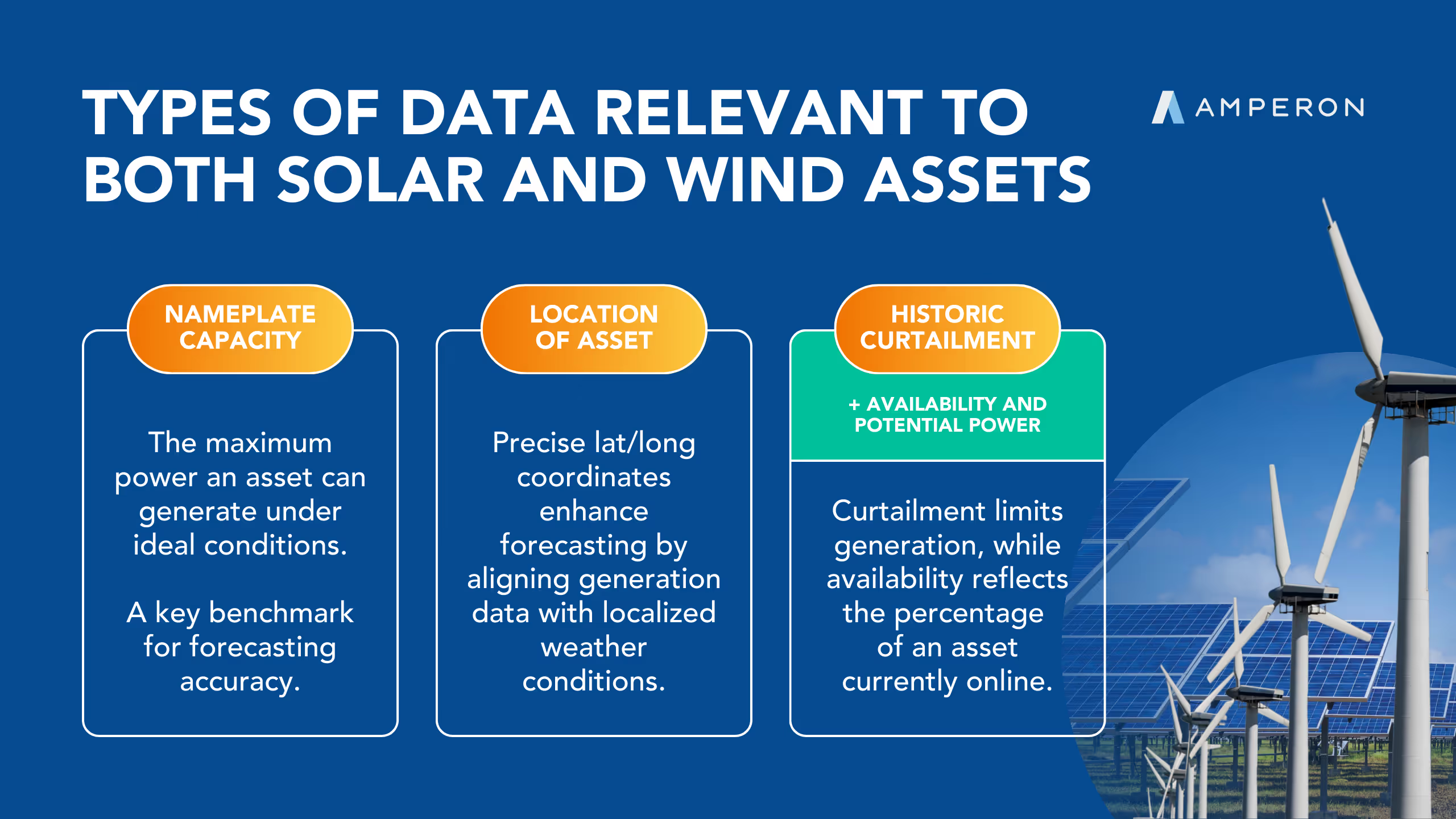
Infographic titled "Types of Data Relevant to Both Solar and Wind Assets" showing three categories: Nameplate Capacity, Location of Asset, and Historic Curtailment with wind turbines and solar panels imagery
Blog
December 10, 2025
Inside our Data: Intro to Renewable Asset Data
Open article
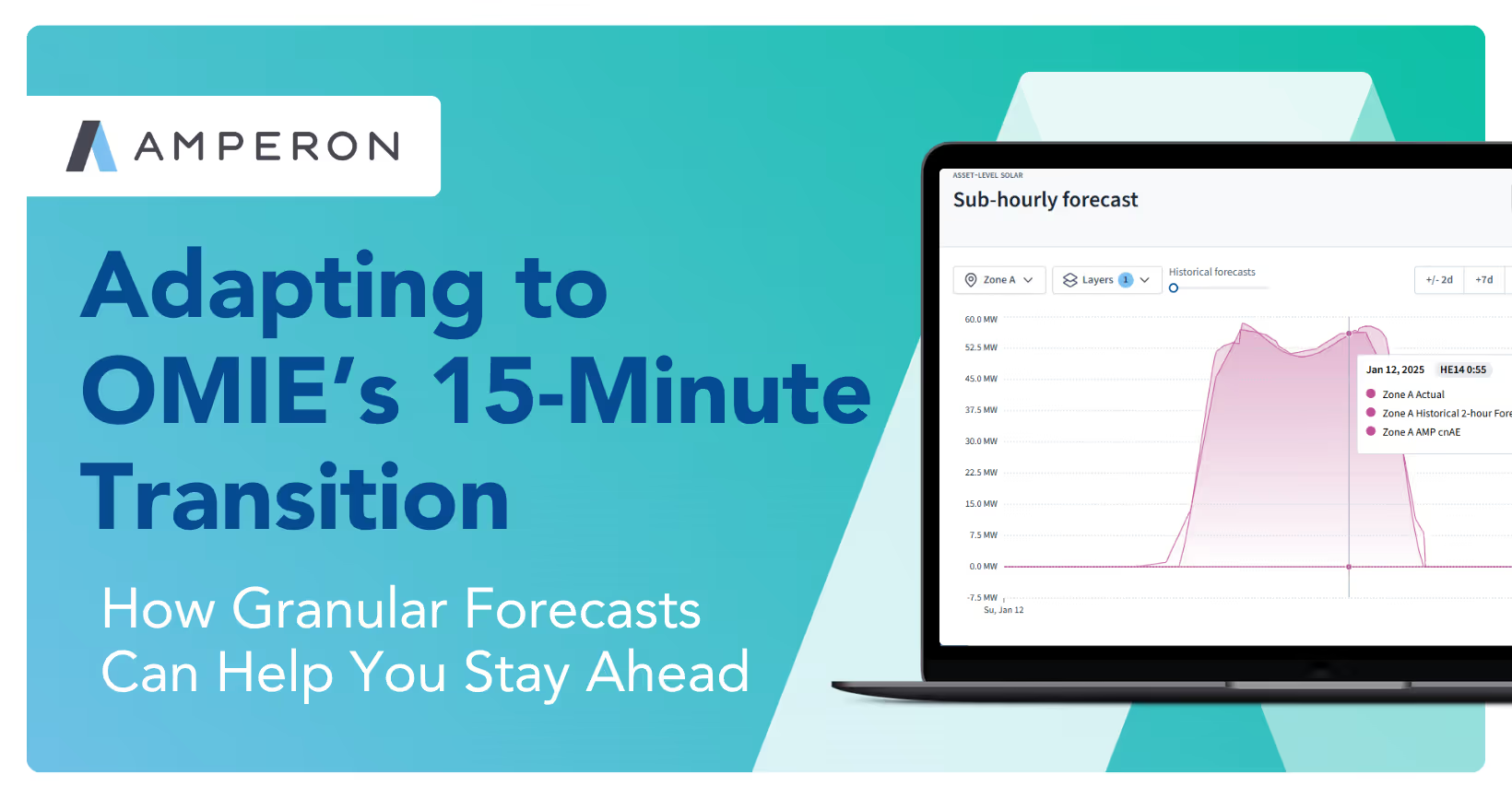
Amperon promotional slide "Adapting to OMIE's 15-Minute Transition: How Granular Forecasts Can Help You Stay Ahead" with laptop showing asset-level solar sub-hourly forecast for January 12, 2025
Blog
December 10, 2025
Adapting to OMIE’s (Portugal and Spain) 15-Minute Transition: How Granular Forecasts Can Help You Stay Ahead
Open article
Blog
December 11, 2025
What the beginning of daylight savings time means for peak pricing
Open article
Amperon presentation slide "How the Grid Changed in 2024" with aerial view of large-scale solar farm installation in agricultural setting at sunset
Blog
December 11, 2025
How the Grid Changed in 2024
Open article
Amperon recap slide for February 14-20 titled "Another cold week on the grid, another good week for Amperon's demand forecasts" with wind turbines in snowy landscape
Blog
December 11, 2025
Another cold week on the grid, another good week for Amperon’s demand forecasts
Open article
Blog
December 11, 2025
The Future of Western Power Markets: Why Implementing a Day-Ahead Market Matters
Open article
Blog
December 11, 2025
Harnessing the power of sub-hourly and hourly forecasts for wind assets
Open article
Blog
December 11, 2025
Forecasting for the Super Bowl: How much does the big game really affect demand?
Open article
Amperon promotional banner stating "33% more accurate in MISO" with blue gradient background and solar panels with wind turbines imagery
Blog
December 11, 2025
Best Demand and Net Demand Forecasting Calls to End 2024
Open article
Amperon slide featuring Punxsutawney Phil prediction reference titled "What Punxsutawney Phil's prediction for 6 more weeks of winter really means for the grid" with snowy groundhog image
Blog
December 11, 2025
What Punxsutawney Phil’s prediction for 6 more weeks of winter really means for the grid
Open article
Blog promotional graphic on navy background titled "New Blog: Why a hybrid regression/ML approach outperforms in energy forecasting" with layered visualization showing Linear Regression, Boosted Trees, and Additional secondary models
Blog
November 18, 2025
Why a hybrid regression/ML approach outperforms in energy forecasting
Open article
Blog
June 3, 2025
Europe 2024 Best Amperon Forecasting Calls and Trends to Watch
Open article
Title slide reading "Part 1: Inside Our Data: The Importance of Granular Weather Data" by Lily Bowdler from Amperon
Blog
November 18, 2025
Inside our Data: The Importance of Granular Weather Data
Open article
Bar chart showing 2025 Highest ISO Demand Levels So Far across four ISOs: ERCOT (68.9 GW), PJM (126.8 GW), MISO (97.9 GW), and SPP (43.1 GW)
Blog
November 18, 2025
Déjà vu? With one cold snap down, will we have a repeat of last MLK weekend?
Open article
Blog promotional slide "The first winter cold snap is here, but will it break records?" with laptop displaying PJM weather data showing 5-year, 10-year, and 30-year normals for various cities
Blog
November 18, 2025
First winter cold snap is here, but will it break records?
Open article
Blog
June 3, 2025
Looking Back (and Ahead): A Year-end Q&A with Amperon CEO Sean Kelly
Open article
Line graph comparing Ireland Wind Generation forecasts for August 20-26, showing Actual Wind, Amperon Day Ahead Wind Forecast, and EirGrid Day Ahead Wind Forecast (duplicate of image 43)
Blog
November 18, 2025
How strong winds in Ireland left power market stakeholders exposed
Open article
Line graph of CAISO demand for Indigenous Peoples Day 2024 (October 11-14), showing Duck Curve pattern and comparing Amperon Day Ahead, ISO Day Ahead, and Actuals
Blog
November 18, 2025
Forecasting for the holidays: How holidays affect demand patterns
Open article
Blog
June 3, 2025
When tech buys nuclear, who wins?
Open article
Blog
November 18, 2025
Unlocking new standards in solar forecasting to maximize asset efficiency
Open article
Marketing graphic titled "What's Happening with Price Forecasting? A Q&A with Amperon CEO Sean Kelly" featuring professional headshot of Sean Kelly
Blog
November 18, 2025
What’s Happening with Price Forecasting? A Q&A with Amperon CEO Sean Kelly
Open article
Blog
November 18, 2025
Taking Advantage of Amperon’s Net Demand Forecast on Snowflake
Open article
Line graph showing ES (Spain) Demand for August 15 Feast of Assumption, with table comparing Peak Demand, Amperon APE, and ES APE percentages across four dates, plus lower panel showing electricity production and spot prices
Blog
November 18, 2025
2024 Energy Demand Trends: What Happened During 3 Recent EU Holidays
Open article
Blog
June 3, 2025
PJM Capacity Auction: Record Pricing and Delays
Open article
Multi-panel visualization showing ERCOT Demand for July 1-5, including line graphs comparing Amperon and ERCOT forecasts, data tables showing MAPE percentages for different dates, and gauge charts showing average MAPE (1.02% AMP, 1.69% ISO)
Blog
November 18, 2025
Amperon’s best energy forecasting calls for Summer 2024
Open article
Marketing text overlay on transmission tower background stating "Amperon's new price forecast tackles ERCOT's volatility and helps market participants mitigate risks"
Blog
November 18, 2025
Amperon’s new price forecast tackles ERCOT’s volatility and helps market participants mitigate risks
Open article
Marketing graphic announcing "Expanding Amperon's coverage on Snowflake" for Demand and Net Demand across North America and Europe ISO/TSOs, featuring screenshot of Snowflake marketplace interface
Blog
November 18, 2025
Expanding Amperon’s coverage on Snowflake: Demand and Net Demand for North America and Europe ISO/TSOs
Open article
Video thumbnail from webinar titled "Powering Data-Driven Decisions: Enhance Your Energy Trading Game with Amperon + Snowflake" featuring Amperon and Snowflake logos, dated September 26, 2024, with transmission tower image and video progress indicator show
Blog
November 18, 2025
Powering Data-Driven Decisions: Enhance your energy trading game with Amperon & Snowflake
Open article
Photograph of single wind turbine on hilltop with autumn-colored foliage in foreground against clear blue sky
Blog
November 18, 2025
Analysis of spring curtailments in preparation for fall
Open article
Marketing graphic announcing "Introducing Asset-Level Wind Short-Term Forecasts" with photograph of wind turbines against mountain landscape backdrop
Blog
November 18, 2025
Expanding generation forecast capabilities into wind
Open article
ERCOT West Zone Net Demand Short-Term Forecast for August 11-13, 2024, showing three stacked area graphs for Net Demand, Solar Generation, and Wind Generation, with explanatory text about negative net load, curtailments, and congestion implications
Blog
November 18, 2025
Granular insights from grid net demand forecasts: Importance of zone-level forecasting
Open article
Blog
December 2, 2025
Why solar forecasts and accuracy metrics are a big deal
Open article
Satellite view from space showing large hurricane system with visible eye wall approaching Caribbean islands, showing Earth's curvature against black space background
Blog
November 18, 2025
Weaker hurricane season due to Saharan dust
Open article
Close-up photograph of solar panel array showing dust, dirt, and debris accumulation on photovoltaic panel surfaces, demonstrating need for maintenance
Blog
November 18, 2025
Hailstorms: How they can impact your solar farm
Open article
Nighttime satellite image showing hurricane system with well-defined spiral structure making landfall on southeastern United States coastline with visible city lights
Blog
November 18, 2025
Forecasting for SERC During Tropical Storm Debby
Open article
Photograph of dark chalkboard filled with mathematical equations, formulas, and diagrams including algebraic expressions, chemical structures, geometric drawings, and calculus notations written in white chalk
Blog
November 18, 2025
The different kinds of forecasting metrics
Open article
Blog
November 18, 2025
Amperon’s industry-leading forecasts now available to transact on the Microsoft Azure Marketplace
Open article
Aerial photograph of wind farm installation with three large white wind turbines on rolling green hills with mountains in background and scattered buildings in rural landscape
Blog
November 18, 2025
Reminiscing on the summer’s heat waves... so far
Open article
Marketing graphic announcing "Introducing Solar Sub-Hourly Generation Forecasts" with photograph of solar panel installation on ground-mounted framework in grassy field
Blog
November 18, 2025
Harnessing sub-hourly solar forecasts for power markets trading
Open article
Blog
November 18, 2025
Amperon’s methodologies: AI-powered forecasting for the energy transition
Open article
Blog
June 3, 2025
The Double-Edged Sword: Using LLMs in Electricity Market Forecasting
Open article
Satellite image of two tropical cyclone systems near Asian coastline showing clear hurricane eyes and spiral cloud formations over ocean waters with land mass visible on left side
Blog
November 18, 2025
Advanced stress testing for extreme weather
Open article
Blog
June 3, 2025
Enabling Amperon’s short-term grid forecast with Snowflake
Open article
Upward angle photograph of tall electrical transmission tower structure against blue sky with white clouds, showing multiple levels of power line connections and lattice framework construction
Blog
November 18, 2025
Amperon’s best forecasting calls this Spring
Open article
PJM heat wave peak demand forecast comparison table showing Amperon APE vs PJM APE for June 18-23
Blog
November 18, 2025
PJM Heatwave Analysis: Forecasting for 90-degree heat and a new federal holiday
Open article
Seattle city skyline at night featuring the Space Needle with illuminated buildings
Blog
November 18, 2025
A deep dive into what happened MLK weekend in the Pacific Northwest and West Coast
Open article