Product Launch
New Product Alert! Grid Mid-Term Forecast: Probabilistic
Learn More

Mitigating Curtailment Risk With Smarter Wind and Solar Forecasting

How Renewable Asset Owners can Help Protect Revenue Against Congestion, Curtailment, and Negative Pricing through Smarter Solar and Wind Generation Forecasting.

Cameron Odegaard
February 23, 2026
February 23, 2026

Summary

1
Renewable asset owners face rising financial risks from congestion, curtailment, and negative pricing, making accurate forecasting more critical than ever.
2
Traditional physics-based and machine learning models each have gaps, but a hybrid approach captures real‑world behavior while maintaining essential physical context.
3
By integrating asset metadata, localized weather inputs, and clean historical data, smarter forecasting helps operators optimize revenue, mitigate risk, and improve grid resilience.
4
Executive Summary

Renewable asset owners face growing financial risks posed by the world's increasingly complicated grids. To manage these risks, solar and wind operators rely on forecasts to inform their power purchase agreements and power market bidding. This paper evaluates the pros and cons of both physics-based (PB) and machine learning (ML) forecasting models. It then outlines a hybrid approach that can combine the best of both types. This hybrid approach helps protect revenue by improving forecast accuracy, mitigating threats like congestion, curtailment, and negative pricing. For the growing number of battery-tied installations, the hybrid forecasting approach also helps inform optimal battery charging and dispatch.  

Congestion, Curtailment, and Negative Pricing: The Triple Threat to Renewable Asset Owners

Solar and wind operators worldwide face growing financial risks from congestion, curtailments or forced exports, and negative pricing. Grid operators can trigger these effects at any time to maintain grid reliability and keep transmission lines operating effectively. This not only costs asset owners money, but also makes it difficult to predict revenue timing.

Congestion is not just a bottleneck; it’s a revenue risk

When too much generation occurs in a localized area without sufficient local demand, transmission lines become congested. Congestion is a measure of the constraint on transmission when transporting electricity from one region to another.  

In de-regulated markets, this has two key consequences:

  • Price volatility: Congestion heavily influences Locational Marginal Prices (LMPs), creating sharp spikes or collapses depending on where the constraint occurs.
  • Settlement risk: In some cases, congestion can also trigger separate settlement charges, adding another layer of cost exposure.

For load-serving entities, congestion can mean unexpected costs and complex hedging techniques. Modeling these risks requires power flow modeling—a notoriously difficult task that goes far beyond demand forecasting. Factors like weather-driven transmission disruptions, planned outages, parallel flows, and real-time generation availability all make accurate modeling challenging.

For generators, congestion risk cuts even deeper. When constraints arise near a generator’s node, grid operators may assign negative LMPs—meaning the generator must pay to inject power into the system. At that point, owners are forced to curtail, losing revenue opportunities. These swings can occur as quickly as every 5 minutes in real-time markets, making short-term visibility critical for decision-making.

Curtailments increasingly shut down renewables

To maintain reliability in the face of congestion, grid operators can—and often do—order curtailments and forced exports. This is increasingly common in high-renewable grids. In California, for example, CAISO curtailed 3.4 million MWh in 2024, primarily solari—accounting for nearly 7% of the state’s solar generation.ii

Curtailments inevitably mean lost revenue. A June 2025 study on Spain found that just 2.5% curtailed energy reduced net present value for affected PV asset owners by nearly 8% and increased levelized cost of electricity for those projects by over 2%.iii Forced exports can also depress revenues if the exported power clears at lower prices than it would in its home market.

Curtailments introduce additional challenges beyond lost revenue. They can skew forecasting models if unindicative events are treated as actual asset performance. Because curtailments reflect system constraints rather than generation capability, machine learning models that don’t account for this distinction risk compromising accuracy.

It’s worth noting that while the continued expansion of renewables threatens to accelerate curtailments, the rise of battery energy storage in many markets is likely to mitigate this effect.

SPOTLIGHT: CALIFORNIA

In California, abundant mid-day solar generation leads to congestion and curtailment

California has seen steady growth in solar capacity in recent decades thanks to the state’s abundant sun and supportive policies. Mid-day solar generation often exceeds local demand, especially in Southern California’s main hub known as SP15.

Excess supply leads to major congestion costs, curtailments, and exports to prevent grid overloading. Curtailments alone can reach thousands of hours a year, causing significant financial losses for many asset owners. While some assets are able to operate profitably at negative prices thanks to RECs, PPAs, or other contracts, not all assets have this protection.

The Northern California hub NP15 often sees real-time price spikes tied to imports from SP15. These spikes are driven by congestion costs as power flows north. They are especially common during solar-peaking hours, when SP15 has a significant oversupply of generation and therefore negative prices in the South.
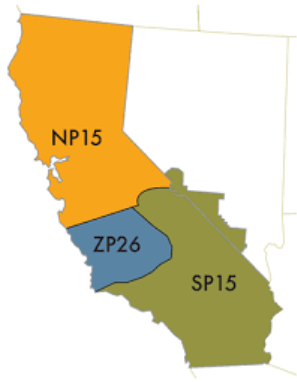
CAISO zones
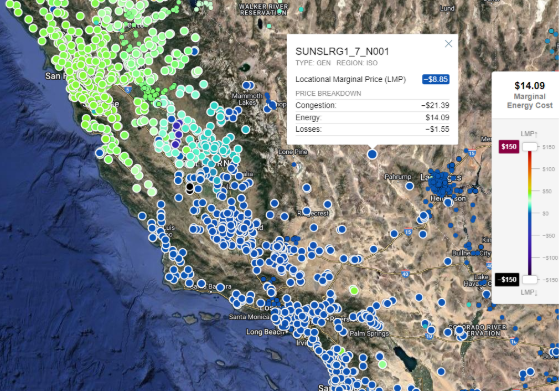
CAISO zonal LMP map example
When over-generation occurs in SP15, power will be dispatched to Northern California (NP15), triggering congestion charges and sending SP15 Locational Marginal Prices (LMP) below zero while spiking NP15 prices.
Sources: CAISOiv, WesternPowerGrid.comv

Negative pricing can force operators to pay to dispatch power

When congestion charges or line losses are sufficiently high, energy prices can go negative. For exposed asset owners without contractual protection, this means they must pay to dispatch power onto the grid. This is a worst-case scenario for many operators, yet it is not uncommon.

Many asset owners are forced to continue operating at negative prices due to contractual obligations or other factors. While some assets are able to operate profitably at negative prices thanks to RECs, PPAs, or other contracts, not all assets have this protection.

These risks are especially acute in markets with a high penetration of renewables. California, for example, frequently sees negative Locational Marginal Prices (LMPs) during the mid-day hours. In 2024, Southern California alone saw 1,180 hours of negative pricing.vi That’s an average of over 3 hours a day year-round, and much of this is concentrated in the shoulder seasons.  

In addition, the median negative price in 2024 was roughly -$17 compared with roughly -$10 in 2023, indicating that both the frequency and magnitude of negative prices have increased.vii  

As the energy landscape evolves, so too must our forecasting methodologies. As the risks of congestion, curtailment, and negative pricing grow and compound, accurate forecasting is becoming more critical every day. Yet, forecasting models often fail to reflect real-world asset behavior or local grid conditions.

SPOTLIGHT: GERMANY

In Germany, wind energy congestion causes fossil plants to come online

Germany’s grid struggles with bottlenecks, especially on north–south transmission corridors, as abundant northern wind generation must be transported to load centers further south. As in California, this can lead to negative pricing, curtailments, and exports to prevent strain on the grid.viii Germany’s DE_LU hub recorded 457 hours of negative electricity pricing in 2024, up from 301 hours in 2023.ix, x

Even with these disincentives in place, Germany’s Transmission System Operators (TSOs) must spend billions of Euros a year on grid stability. Wind power is generally less predictable than solar power on all time scales. Unlike solar, which follows a relatively consistent diurnal pattern, wind can fluctuate unexpectedly, leading to overall increased market risk which could include increased costs, curtailment risks, and reduced market revenues if forecasts are inaccurate.
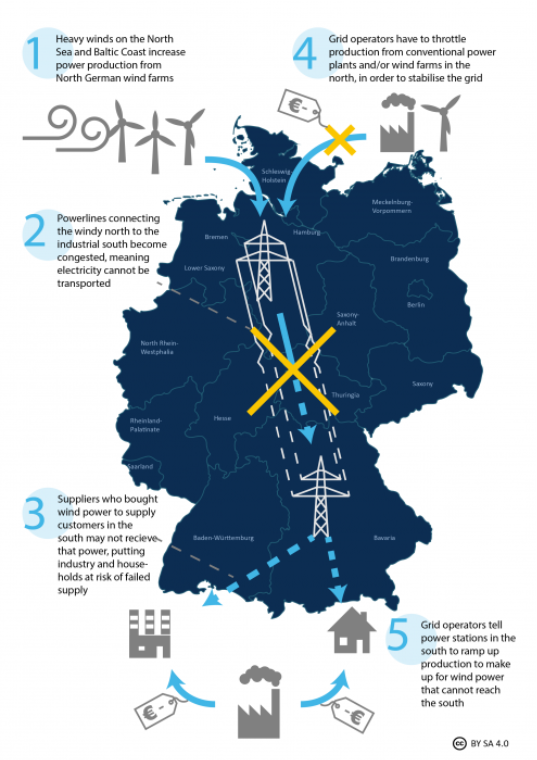
German transmission connections
Key congested lines include Dollern–Sottrum in Lower Saxony and the Kontek HVDC link between Denmark and East Germany, which have experienced congestion for over 1,000 and nearly 2,000 hours annually, respectively.
Source: EnergyTransition.orgxi


To alleviate these constraints, TSOs issue redispatch orders—reducing output in the North and increasing generation in the South, often from fossil plants. While this helps ensure reliability, it imposes operational uncertainty on renewable asset owners while also failing to reduce carbon emissions as promised. Unlike CAISO, where battery storage is increasingly mitigating curtailments, the nature and geography of German grid constraints make forecasting and redispatch particularly complex, requiring models that incorporate local congestion patterns and cross-border flows.

SPOTLIGHT: BRAZIL

In Brazil, curtailment is putting the energy sector on the brink

Curtailment has reached extreme levels in Brazil, driving a fervorous discussion about grid reform. Wind and solar curtailments grew 230% year over year from January to August 2025, reaching nearly 20 TWh just two-thirds the way through 2025—double the figure from the full year prior. Most curtailments, including all those for “energy” or “reliability” reasons, are not currently eligible for compensation under agency rules, shifting significant cost risk to generators.xii

Brazilian solar and wind curtailment charts
Curtailment reached roughly 27% for solar and 16% for wind from January through August 2025 cumulatively, and the trend is accelerating rapidly.
Source: Rystad Energyxiii

The economic impacts are massive. The National Interconnected System (SIN)’s average curtailment is over 3,000 MW, causing losses of R$3.2 billion (~US$600 million) to the local energy sector.xiv One research group estimates that curtailment risk is adding R$40/MW (~US$7/MW) to the cost of new renewable PPAs in Brazil.xv

All this has led to urgent calls for both short-term measures to protect the interests of generators as well as long-term measures to modernize the transmission system, reform regulatory markets, and more. If implemented well, these reforms could significantly reduce curtailment risk and improve investment confidence. In the meantime, asset owners must develop new processes to forecast and mitigate curtailment impacts.

Wind and Solar Forecasting Methodologies: The Pros and Cons of Physics-Based and Machine Learning Models

Accurate renewable generation forecasting allows asset owners to bid optimal capacity and energy into power markets. Forecasting is not new, but the methods used are rapidly evolving. Traditional physics-based models simulate the real world based on theoretical data. Machine learning-based forecasting makes inferences informed by real-world data. Each methodology has distinct benefits and limitations.  

Physics-Based Wind and Solar Forecasting Provides Situational Context

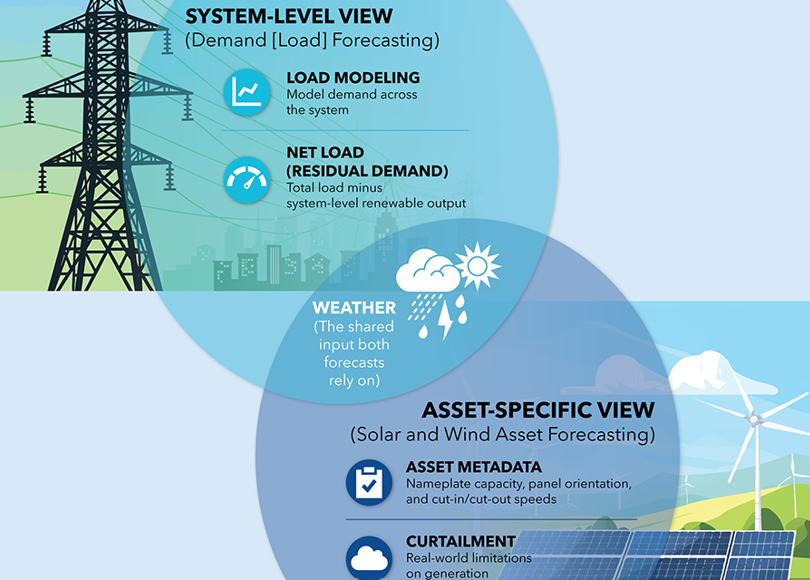
Traditional forecasting informs decision making grounded in the physical boundaries and operating constraints of a system—factors that historical data alone can only approximate. All physics-based models include variables like location and nameplate capacity. Additional wind asset variables include power curves, cut-in and cut-out speeds, etc., while common solar asset variables include panel tilt (slope) and azimuth (degrees from true north). These static variables are then combined with weather data to predict actual output.

Advantages of Physics-Based Energy Forecasting Models

Physics-based (PB) models provide situational context that grounds decisions in reality. The laws of physics dictate certain parameters like the relationship between wind speed and friction or a solar panel’s maximum efficiency. No prediction should ever stray from these principles. This keeps traditional forecasting methods relevant today and into the future.

Limitations of Physics-Based Energy Forecasting Models

Physics-based models assume ideal conditions. They try to simulate a hypothetical world, but it’s nearly impossible to predict real-world performance without incorporating historical behavior. If a site is experiencing equipment degradation, panel soiling, or obstruction, for example, asset metadata will be unable to capture the full picture.

Additionally, because weather is their only ongoing input, PB models are extremely reliant on accurate weather data and weather model parameters. When models depend on interpolated or gridded weather data, such as from an ISD station, their relevance to actual site conditions can be limited. Moreover, the choice of weather variables matters. Temperature, for instance, may actually be less predictive of wind output than it is of energy demand.

Machine Learning-Based Wind and Solar Forecasting Captures Historical Context

Machine learning (ML) models use a type of Artificial Intelligence (AI) to make inferences based on real-world data rather than hard-coded rules. It trains a model based on historical data, then it applies this model to new data. New data can also be fed back into model training, allowing ML models to adapt to evolving situations and continuously improve.  

Advantages of Machine Learning Energy Forecasting Models

ML models tend to outperform physics-based models in detecting site-specific patterns. They can learn from the real-world impact of factors that physics models often miss, such as equipment degradation or malfunction. Not only can they incorporate historical patterns, but they can continue to learn from new events. This makes ML forecasting extremely popular today.

Limitations of Machine Learning Energy Forecasting Models

For proper ML model training, clean and well-groomed data is essential. Many renewable assets experience curtailments or outages, which introduces additional complexity—especially when asset owners aim to forecast full, un-curtailed production rather than actual delivered energy. In these cases, it’s critical that curtailment periods and outages are excluded from model training to avoid skewed results.

Unfortunately, many asset owners don’t store this data reliably in their data lakes due to SCADA limitations, compromising the accuracy of the training process. Variables like max power (also known as setpoint or curtailment), potential power (often referred to as High Sustainable Limit or HSL), and availability (representing outages) are key to understanding these anomalous events, yet they are not always readily available.

Summary of Renewable Energy Forecasting Methodologies

Traditional and AI-powered forecasting both have strenghts and limitations. Physics models provide some grounding in absolute truths, while machine learning models can capture real-world data and adapt to changing circumstances. Physics models rely on idealized assumptions and weather inputs, while ML models can be distorted by curtailments and outages.  

The Best of Both: A Hybrid Approach to Wind and Solar Forecasting

To mitigate risk, operators can use a hybrid forecasting approach that combines the best of both machine learning and physics-based models. A hybrid model can capture the strengths of both methodologies while helping overcome the limitations inherent in each.

Amperon addresses real-world issues like equipment degradation, inverter malfunctions, panel soiling, and obstructions by incorporating historical trends and continuously updated data, as well as by placing more weight on recent performance to reflect current asset behavior.

We also ingest key metavariables like azimuth and tracking (for solar) and cut-in/cut-out speeds (for wind), providing essential physical context that purely ML-based models may overlook.  

To ensure weather inputs are as relevant as possible, we generate localized forecast points based on each asset’s exact latitude and longitude, capturing hyper-local fluctuations that can significantly affect generation.  

For curtailment and outage handling, asset owners have the option to provide data like max power, potential power, and availability, which allows us to exclude non-representative periods from model training. For cases where such data is not available, we’ve also built a curtailment detection system that identifies significant underperformance and automatically excludes those periods from the training dataset.

Forecasting Is Even More Important for Batteries and Hybrid Installations

The rise of battery energy storage systems, especially those paired with renewable generation, is directly correlated with the rise in congestion, negative pricing, and curtailments. While it would be easy to think energy storage would make accurate renewable energy forecasting less important, the opposite is true.

For battery operators, knowing when to charge and when to dispatch is extremely important for energy arbitrage. Whether for energy storage systems alone or for hybrid renewable-plus-storage installations, maximizing revenue requires not only accurate grid-level forecasts of demand and prices, but also highly granular wind and solar forecasts.  

These detailed predictions allow owners to anticipate renewable energy available for storage in advance of peak net load periods. This helps minimize charging costs while also making maximal power available during opportune times, increasing revenue for battery operators while simultaneously improving grid reliability, efficiency, and emissions.

A Note on Evaluating Renewable Energy Forecasting Error

For renewable asset owners, evaluating forecast accuracy is more complex than it is for traditional load forecasting. Common metrics like Mean Absolute Percentage Error (MAPE) break down when actual generation values approach zero—a frequent occurrence for solar and wind assets—resulting in misleading or infinite error values. Alternatives like normalized MAE (nMAE) and RMSE address some of these issues but introduce others: nMAE fails to account for seasonal variation, while RMSE is sensitive to asset scale and doesn’t reflect the relative impact of errors across different capacities.

A more effective metric for asset-level forecasting is capacity-normalized MAE (cnMAE), which adjusts for both seasonal variability and asset size. This allows asset owners to compare performance across diverse assets and time periods with greater confidence. By using cnMAE, operators gain a clearer picture of how well forecasts align with actual generation potential—critical for optimizing dispatch decisions, managing risk, and improving revenue outcomes. See Amperon’s cnMAE white paper for further details.

Conclusion

In an era of increasing renewable generation and grid volatility, reliable asset-level forecasting is more critical than ever. Advances in wind and solar generation forecasting help asset owners protect revenue against threats like congestion, curtailment, and negative pricing.  

Both physics-based and machine learning forecasting methodologies have unique strengths and weaknesses. By addressing the gaps in each, hybrid forecasting sets a new standard for forecast reliability.  

By integrating asset-specific metadata, localized weather inputs, and machine learning trained on clean historical data, Amperon helps operators anticipate grid constraints, optimize battery dispatch, and reduce exposure to market volatility.

Learn more about Amperon’s short-term wind and solar forecasting methodologies here.
Contact Amperon to discuss your renewable asset optimization and risk mitigation strategies.

References:

i https://solarquarter.com/2025/06/04/california-faces-rising-solar-and-wind-curtailments-amid-rapid-growth-in-renewable-energy-capacity/  

ii https://www.energy.ca.gov/data-reports/energy-almanac/california-electricity-data/2024-total-system-electric-generation  

iii https://iris.uniroma1.it/retrieve/7cdc9f28-612e-41d1-bec2-75b6a976af61/Micheli_Energy  

iv https://oasis.caiso.com/mrioasis/logon.do

v http://www.westernpowergrid.com/2023/10/15/electricity-markets-isos-and-locational-marginal-pricing/  

vi https://www.renewableenergyworld.com/solar/negative-prices-in-caiso-what-ppa-buyers-and-renewable-developers-need-to-know/  

vii https://www.renewableenergyworld.com/solar/negative-prices-in-caiso-what-ppa-buyers-and-renewable-developers-need-to-know/  

viii https://www.sciencedirect.com/science/article/pii/S0306261923017154  

ix https://www.pv-magazine.com/2025/01/06/germany-records-457-hours-of-negative-electricity-prices-in-2024/  

x https://www.sciencedirect.com/science/article/pii/S0306261923017154#dfig1  

xi https://www.cleanenergywire.org/factsheets/re-dispatch-costs-german-power-grid

AI-driven Forecasting

Our advanced machine learning methodology delivers the accuracy you need to optimize operations and maximize profits.

  • 40K weather points from 4 vendors
  • 15-day short-term forecasts that update sub-hourly
  • Globally available
  • Leading UI/UX or API delivery
Book a demo

Want 3x more accurate forecasts? Let's talk.

Book a demo

Related articles

Left arrow icon for navigationRight arrow icon for navigation
Blog
February 23, 2026
Mitigating Curtailment Risk With Smarter Wind and Solar Forecasting
Open article
Blog
February 23, 2026
cnMAE: The Right Metric for Evaluating Solar & Wind Forecasts
Open article
Blog
February 16, 2026
How to Use Wind and Solar Forecasts: Net Load Forecasting and Day-Ahead Optimization
Open article
Blog
February 11, 2026
Uri vs. Fern: How ERCOT Learned to Bend Without Breaking
Open article
Blog
February 3, 2026
Before the Cold Hit: Early Demand Signals Behind January’s Arctic-Driven Power Price Surge
Open article
Blog
February 12, 2026
The Evolution of Energy Forecasting: From Deterministic to Probabilistic
Open article
Blog
February 3, 2026
Hedging Tail Risk: Term Traders Get a Powerful New Risk Management Tool
Open article
Blog
January 26, 2026
Sub-Hourly STF Improves Day-Ahead Positioning in the Era of Renewables
Open article
Blog
January 26, 2026
Behind PJM’s 800% Increase in Capacity Prices and Trump’s Emergency Auction Plan
Open article
Blog
January 8, 2026
Germany Proves Transmission is Just as Critical as Generation
Open article
Blog
January 8, 2026
How Amperon Won the Holidays
Open article
Blog
January 23, 2026
6 Grid Trends to Watch in 2026
Open article
Blog
December 12, 2025
Battery Energy Storage: ERCOT vs. CAISO
Open article
Blog
December 19, 2025
European Power Traders Finally Get One-Stop Forecasting
Open article
Blog
December 6, 2025
The Pacific Northwest Risks a 6 GW Shortfall This Winter
Open article
Blog
December 17, 2025
With Millions On the Line, Amperon Called Cold Snap 33 Days Out
Open article
Blog
December 5, 2025
Chilean Solar and Wind Asset Owners Face Hourly Reporting Under New Market Structure
Open article
Blog
December 5, 2025
Can PJM Keep Up with Exponential Load Growth?
Open article
Blog
December 5, 2025
US Winter Weather Outlook 2025–2026: Mild on Paper, Volatile in Practice
Open article
Blog
January 23, 2026
Ontario’s Day-Ahead Market is a Renewables Profitability Test
Open article
Blog
December 5, 2025
US Solar and Wind Curtailment Is Exploding
Open article
Blog
December 5, 2025
Navigating the RTC+B Paradigm Shift
Open article
Case study banner reading “Nailing MISO’s Fall 2025 Coincident Peak” with a computer displaying grid demand forecasts
Blog
December 5, 2025
Nailing MISO's Fall 2025 Coincident Peak: A Week-Ahead Perfect Call
Open article
Amperon MTF model visualization displaying market trends and forecasts
Blog
December 5, 2025
Unlocking Intelligent Term Trading and Seasonal Planning  
Open article
Blog post header with palm tree in hurricane winds asking Why Has This Hurricane Season Been So Quiet with Amperon branding
Blog
December 5, 2025
Why Has This Hurricane Season Been So Quiet?
Open article
Table showing parallel flow congestion scenarios across different energy markets including ISO/RTO, WEIM, WEIS, Markets+, and EDAM with scheduled delivery systems and mitigation strategies
Blog
December 5, 2025
CAISO Breaks the Transmission Hedge
Open article
Amperon blog post graphic asking High ERCOT Demand, Low Wind, and No Price Spike? with load forecast chart for August 18, 2025
Blog
December 5, 2025
High ERCOT Demand, Low Wind, and No Price Spike?
Open article
ISONE May hourly average load comparison chart showing data from 2023, 2024, and 2025 with peak loads around 13,534 MW at HE17-18
Blog
December 5, 2025
Electrification and BTM Solar: Reshaping Demand in ISO New England
Open article
Line graph showing MISO Net Load from 2022-2025 comparing hourly load patterns ranging from 50,000 to 90,000 MW across 24-hour period
Blog
December 9, 2025
The Rise of the Duck Curve in ERCOT: A Shift in Net Demand Peak and the Future of Solar Power Integration
Open article
Amperon market analysis titled Where's the Chaos? ERCOT's Surprisingly Quiet Summer with curved line graph showing peak demand trends from 2022-2025
Blog
December 5, 2025
Where’s the Chaos? ERCOT’s Surprisingly Quiet Summer
Open article
Amperon forecasted load versus prediction time by weather vendor chart for PJM on June 24, 2025, showing settled demand at 158.2 GW with multiple vendor forecasts (ENS_1, NBM, DTN, AG2)

Blog
December 8, 2025
PJM Breaks 10-Year Peak Load Record — and Amperon Saw It Coming 7 Days Out
Open article
Blog
December 8, 2025
PJM Forecast: June 23–25 Heat Wave May Shatter Summer Expectations
Open article
Blog
December 8, 2025
ISONE’s First Heat Spike of Summer- and Amperon Nailed It
Open article
Amperon whitepaper cover titled Cost of Uncertainty: The Challenges and Value of Accurate Price Forecasting with download button, dated March 2025
Blog
December 10, 2025
Why Wholesale Electricity Prices are ESPECIALLY Volatile in Texas
Open article
Blog
December 10, 2025
Powering Profitable Growth for Retail Electricity Providers: Turn Load Forecasting into Your Competitive Edge
Open article
Blog
December 10, 2025
Navigating ERCOT’s 4CP Program: Key Updates and Strategic Preparation for 2025
Open article
Amperon promotional banner announcing sub-hourly grid forecasts for European TSOs now available, featuring transmission tower with geometric orange and blue design elements
Blog
December 10, 2025
Europe’s Shift to 15-Minute Power Markets: How Amperon Helps You Prepare for Market Evolution
Open article
Amperon blog post graphic titled "The Shape Shift: How Texas Net Demand Transitions from Shoulder to Summer" with wind turbine image
Blog
December 10, 2025
The Shape Shift: How Texas Net Demand Transitions from Shoulder to Summer
Open article
Amperon presentation slide titled "ERCOT's Evolving Price Dynamics 2021-2024 Analysis" with sunset transmission tower image
Blog
December 11, 2025
ERCOT’s Evolving Price Dynamics [2021-2024 Analysis]
Open article
A promotional image announcing the introduction of real-time grid price forecasts now live in ERCOT, featuring Amperon branding
Blog
December 10, 2025
Amperon Expands Forecasting Capabilities with Real-Time Price Predictions in ERCOT
Open article
Blog
December 10, 2025
MISO’s VOLL Change Could Reshape Scarcity Pricing and Reliability Signals
Open article
Blog
December 10, 2025
Why Behind-the-meter Solar Complicates Spring Forecasting
Open article
Comparison table showing solar and wind forecasting capabilities across Machine Learning, Physics-based, and Amperon (ML+PB) approaches for partial asset metadata, soiling, equipment degradation, biased weather, and curtailment
Blog
December 10, 2025
How to Forecast Energy Generation for Wind or Solar Assets
Open article
Day-ahead grid MAPE summary table for 2024 showing 12-month average comparison of ISO MAPE, Amperon MAPE past models, current models, and improvement percentages across multiple ISOs (AESO, CAISO, ERCOT, ISONE, MISO, NYISO, PJM, SERC, SPP, CH, DK, ES, IE)
Blog
December 10, 2025
Always Innovating: Amperon’s New Techniques to Improve Energy Forecasting
Open article
Amperon recap slide for April 7 titled "Why prices in ERCOT soared to $4000 per MW" with pastoral field landscape at golden hour
Blog
December 10, 2025
High Net Demand and Outages Caused Recent Price Spike in ERCOT
Open article
Amperon ebook promotional banner "Price Forecasting: Cost of Uncertainty - The Challenges and Value of Accurate Price Forecasting" with free ebook download button on gradient blue-green background
Blog
December 10, 2025
Are ERCOT’s morning ramp DA prices really higher than summer?
Open article
Infographic titled "Types of Data Relevant to Both Solar and Wind Assets" showing three categories: Nameplate Capacity, Location of Asset, and Historic Curtailment with wind turbines and solar panels imagery
Blog
December 10, 2025
Inside our Data: Intro to Renewable Asset Data
Open article
Amperon promotional slide "Adapting to OMIE's 15-Minute Transition: How Granular Forecasts Can Help You Stay Ahead" with laptop showing asset-level solar sub-hourly forecast for January 12, 2025
Blog
December 10, 2025
Adapting to OMIE’s (Portugal and Spain) 15-Minute Transition: How Granular Forecasts Can Help You Stay Ahead
Open article
Blog
December 11, 2025
What the beginning of daylight savings time means for peak pricing
Open article
Amperon presentation slide "How the Grid Changed in 2024" with aerial view of large-scale solar farm installation in agricultural setting at sunset
Blog
December 11, 2025
How the Grid Changed in 2024
Open article
Amperon recap slide for February 14-20 titled "Another cold week on the grid, another good week for Amperon's demand forecasts" with wind turbines in snowy landscape
Blog
December 11, 2025
Another cold week on the grid, another good week for Amperon’s demand forecasts
Open article
Blog
December 11, 2025
The Future of Western Power Markets: Why Implementing a Day-Ahead Market Matters
Open article
Blog
December 11, 2025
Harnessing the power of sub-hourly and hourly forecasts for wind assets
Open article
Blog
December 11, 2025
Forecasting for the Super Bowl: How much does the big game really affect demand?
Open article
Amperon promotional banner stating "33% more accurate in MISO" with blue gradient background and solar panels with wind turbines imagery
Blog
December 11, 2025
Best Demand and Net Demand Forecasting Calls to End 2024
Open article
Amperon slide featuring Punxsutawney Phil prediction reference titled "What Punxsutawney Phil's prediction for 6 more weeks of winter really means for the grid" with snowy groundhog image
Blog
December 11, 2025
What Punxsutawney Phil’s prediction for 6 more weeks of winter really means for the grid
Open article
Blog promotional graphic on navy background titled "New Blog: Why a hybrid regression/ML approach outperforms in energy forecasting" with layered visualization showing Linear Regression, Boosted Trees, and Additional secondary models
Blog
November 18, 2025
Why a hybrid regression/ML approach outperforms in energy forecasting
Open article
Blog
June 3, 2025
Europe 2024 Best Amperon Forecasting Calls and Trends to Watch
Open article
Title slide reading "Part 1: Inside Our Data: The Importance of Granular Weather Data" by Lily Bowdler from Amperon
Blog
November 18, 2025
Inside our Data: The Importance of Granular Weather Data
Open article
Bar chart showing 2025 Highest ISO Demand Levels So Far across four ISOs: ERCOT (68.9 GW), PJM (126.8 GW), MISO (97.9 GW), and SPP (43.1 GW)
Blog
November 18, 2025
Déjà vu? With one cold snap down, will we have a repeat of last MLK weekend?
Open article
Blog promotional slide "The first winter cold snap is here, but will it break records?" with laptop displaying PJM weather data showing 5-year, 10-year, and 30-year normals for various cities
Blog
November 18, 2025
First winter cold snap is here, but will it break records?
Open article
Blog
June 3, 2025
Looking Back (and Ahead): A Year-end Q&A with Amperon CEO Sean Kelly
Open article
Line graph comparing Ireland Wind Generation forecasts for August 20-26, showing Actual Wind, Amperon Day Ahead Wind Forecast, and EirGrid Day Ahead Wind Forecast (duplicate of image 43)
Blog
November 18, 2025
How strong winds in Ireland left power market stakeholders exposed
Open article
Line graph of CAISO demand for Indigenous Peoples Day 2024 (October 11-14), showing Duck Curve pattern and comparing Amperon Day Ahead, ISO Day Ahead, and Actuals
Blog
November 18, 2025
Forecasting for the holidays: How holidays affect demand patterns
Open article
Blog
June 3, 2025
When tech buys nuclear, who wins?
Open article
Blog
November 18, 2025
Unlocking new standards in solar forecasting to maximize asset efficiency
Open article
Marketing graphic titled "What's Happening with Price Forecasting? A Q&A with Amperon CEO Sean Kelly" featuring professional headshot of Sean Kelly
Blog
November 18, 2025
What’s Happening with Price Forecasting? A Q&A with Amperon CEO Sean Kelly
Open article
Blog
November 18, 2025
Taking Advantage of Amperon’s Net Demand Forecast on Snowflake
Open article
Line graph showing ES (Spain) Demand for August 15 Feast of Assumption, with table comparing Peak Demand, Amperon APE, and ES APE percentages across four dates, plus lower panel showing electricity production and spot prices
Blog
November 18, 2025
2024 Energy Demand Trends: What Happened During 3 Recent EU Holidays
Open article
Blog
June 3, 2025
PJM Capacity Auction: Record Pricing and Delays
Open article
Multi-panel visualization showing ERCOT Demand for July 1-5, including line graphs comparing Amperon and ERCOT forecasts, data tables showing MAPE percentages for different dates, and gauge charts showing average MAPE (1.02% AMP, 1.69% ISO)
Blog
November 18, 2025
Amperon’s best energy forecasting calls for Summer 2024
Open article
Marketing text overlay on transmission tower background stating "Amperon's new price forecast tackles ERCOT's volatility and helps market participants mitigate risks"
Blog
November 18, 2025
Amperon’s new price forecast tackles ERCOT’s volatility and helps market participants mitigate risks
Open article
Marketing graphic announcing "Expanding Amperon's coverage on Snowflake" for Demand and Net Demand across North America and Europe ISO/TSOs, featuring screenshot of Snowflake marketplace interface
Blog
November 18, 2025
Expanding Amperon’s coverage on Snowflake: Demand and Net Demand for North America and Europe ISO/TSOs
Open article
Video thumbnail from webinar titled "Powering Data-Driven Decisions: Enhance Your Energy Trading Game with Amperon + Snowflake" featuring Amperon and Snowflake logos, dated September 26, 2024, with transmission tower image and video progress indicator show
Blog
November 18, 2025
Powering Data-Driven Decisions: Enhance your energy trading game with Amperon & Snowflake
Open article
Photograph of single wind turbine on hilltop with autumn-colored foliage in foreground against clear blue sky
Blog
November 18, 2025
Analysis of spring curtailments in preparation for fall
Open article
Marketing graphic announcing "Introducing Asset-Level Wind Short-Term Forecasts" with photograph of wind turbines against mountain landscape backdrop
Blog
November 18, 2025
Expanding generation forecast capabilities into wind
Open article
ERCOT West Zone Net Demand Short-Term Forecast for August 11-13, 2024, showing three stacked area graphs for Net Demand, Solar Generation, and Wind Generation, with explanatory text about negative net load, curtailments, and congestion implications
Blog
November 18, 2025
Granular insights from grid net demand forecasts: Importance of zone-level forecasting
Open article
Blog
December 2, 2025
Why solar forecasts and accuracy metrics are a big deal
Open article
Satellite view from space showing large hurricane system with visible eye wall approaching Caribbean islands, showing Earth's curvature against black space background
Blog
November 18, 2025
Weaker hurricane season due to Saharan dust
Open article
Close-up photograph of solar panel array showing dust, dirt, and debris accumulation on photovoltaic panel surfaces, demonstrating need for maintenance
Blog
November 18, 2025
Hailstorms: How they can impact your solar farm
Open article
Nighttime satellite image showing hurricane system with well-defined spiral structure making landfall on southeastern United States coastline with visible city lights
Blog
November 18, 2025
Forecasting for SERC During Tropical Storm Debby
Open article
Photograph of dark chalkboard filled with mathematical equations, formulas, and diagrams including algebraic expressions, chemical structures, geometric drawings, and calculus notations written in white chalk
Blog
November 18, 2025
The different kinds of forecasting metrics
Open article
Blog
November 18, 2025
Amperon’s industry-leading forecasts now available to transact on the Microsoft Azure Marketplace
Open article
Aerial photograph of wind farm installation with three large white wind turbines on rolling green hills with mountains in background and scattered buildings in rural landscape
Blog
November 18, 2025
Reminiscing on the summer’s heat waves... so far
Open article
Marketing graphic announcing "Introducing Solar Sub-Hourly Generation Forecasts" with photograph of solar panel installation on ground-mounted framework in grassy field
Blog
November 18, 2025
Harnessing sub-hourly solar forecasts for power markets trading
Open article
Blog
November 18, 2025
Amperon’s methodologies: AI-powered forecasting for the energy transition
Open article
Blog
June 3, 2025
The Double-Edged Sword: Using LLMs in Electricity Market Forecasting
Open article
Satellite image of two tropical cyclone systems near Asian coastline showing clear hurricane eyes and spiral cloud formations over ocean waters with land mass visible on left side
Blog
November 18, 2025
Advanced stress testing for extreme weather
Open article
Blog
June 3, 2025
Enabling Amperon’s short-term grid forecast with Snowflake
Open article
Upward angle photograph of tall electrical transmission tower structure against blue sky with white clouds, showing multiple levels of power line connections and lattice framework construction
Blog
November 18, 2025
Amperon’s best forecasting calls this Spring
Open article
PJM heat wave peak demand forecast comparison table showing Amperon APE vs PJM APE for June 18-23
Blog
November 18, 2025
PJM Heatwave Analysis: Forecasting for 90-degree heat and a new federal holiday
Open article
Seattle city skyline at night featuring the Space Needle with illuminated buildings
Blog
November 18, 2025
A deep dive into what happened MLK weekend in the Pacific Northwest and West Coast
Open article
30-year temperature normals table showing forecasts for cities from Newark to Rockford, June 12-26
Blog
November 18, 2025
June 2024 heat wave - PJM
Open article
Houston demand chart showing May 16 power outage affecting 1 million people with Amperon's weather actuals vs actual load
Blog
November 18, 2025
Storm Analysis: ERCOT’s intense may weather
Open article
Amperon blog header image asking "What is the true carbon impact of your renewable assets?" with solar panels and wind turbines
Blog
November 18, 2025
What is the true carbon impact of your renewable assets?
Open article
White electric fan with yellow and blue ribbons blowing against bright yellow background
Blog
November 18, 2025
Record summer heat is coming, is the grid – and your company – prepared?
Open article
Blog
June 3, 2025
The Western Interconnection’s big day-ahead decision
Open article
Amperon promotional banner introducing Ensemble Forecast and Advanced Weather Package with laptop display
Blog
November 18, 2025
Introducing Amperon's Ensemble Forecast, NBM Integration, and Advanced Weather Package
Open article
Aerial view of large-scale solar panel farm with organized rows in rural landscape
Blog
November 18, 2025
Coincident peak season is coming
Open article
Desert landscape with red sand, sparse vegetation, and blue cloudy sky
Blog
November 18, 2025
WRAP: New forecasting requirements for Western states’ resource adequacy coalition
Open article