As the demand for more sustainable energy solutions grows, the intermittent nature of solar and wind generation poses challenges for asset owners who want to effectively bid into the day ahead and real-time markets. The energy transition will increasingly depend on improving the reliability of wind and solar to maintain an efficient and stable grid, especially as power plants are retired and demand continues to grow.
Between 2024 and 2030, all forms of renewable generation are expected to double, which means independent power producers (IPPs), utilities, and energy traders are staying ahead of the curve by using advanced forecasting methodologies to provide a more granular and, more importantly, accurate view of the grid and their assets.

Solar & Wind Generation Forecasting Challenges
Without precise forecasts, renewable predictions can result in substantial financial losses. Independent power producers and traders using short-term solar forecasts must determine power sales quantities for day-ahead markets and real-time reserve strategies. Renewable forecasts also inform mid- and long-term hedging decisions regarding market pricing.
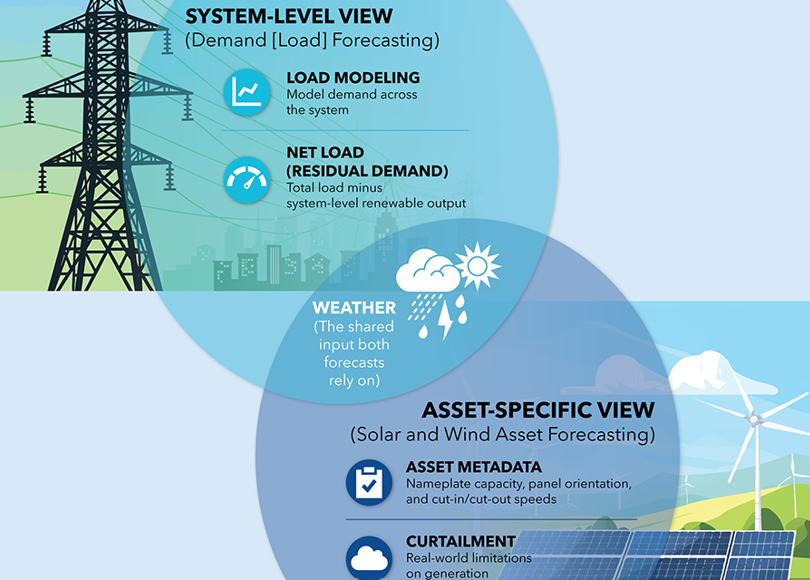
Utilities increasingly depend on accurate renewable forecasts to predict net demand. Managing both generation capacity and customer obligations requires precise forecasting to estimate net demand accurately. Without this visibility, they face expensive real-time market purchases to meet demand or compliance requirements.
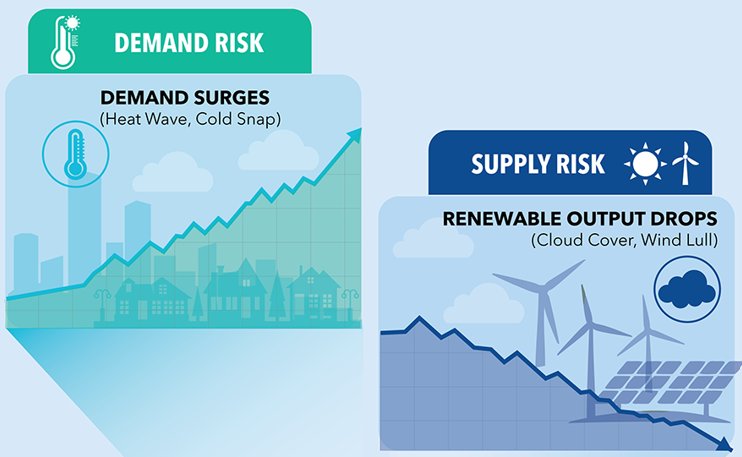
Achieving forecast accuracy presents challenges. Solar and wind output fluctuates due to weather, cloud cover, seasonal variations, and maintenance factors.
Amperon benchmarks forecast accuracy with cnMAE (capacity-normalized Mean Absolute Error): mean absolute error divided by an asset's rated capacity. Normalizing to capacity, not raw output, puts a 5-megawatt solar farm and a 500-megawatt solar farm on the same scale — the comparison that trips up older metrics like MAPE, nMAE, and RMSE.
Solar power forecasting appears straightforward due to predictable sunrise and sunset patterns. However, "asset state"—panel condition, cleanliness, shading, and maintenance status—shifts unpredictably and proves difficult to model, creating uncertainty layers. Despite these challenges, Amperon maintains "a best-in-class solar forecasting benchmark with a cnMAE (capacity-normalized Mean Absolute Error) of 4–6%."
Wind forecasting presents greater difficulty than solar due to inherent high variability across shorter distances. Local terrain including mountains, valleys, and water bodies significantly alter wind patterns. Wind forecasting typically yields lower accuracy, with industry benchmarks around 11% cnMAE. Amperon distinguishes itself with "a wind forecasting benchmark of 8–12%, outperforming many competitors."
All forecasts contain predictive error margins; in volatile markets, small inaccuracies produce substantial financial consequences. According to Amperon's Vice President of Markets and Technical Services, Elliot Chorn: "If you're using solar or wind forecasts, it's important to know just how accurate they are, because errors can be magnified in your trading strategies." He explains that selling 100% of projected solar generation with inaccurate forecasts might result in selling only 90% or incorrectly 110%
Amperon’s Approach to Asset Wind & Solar Forecasting
While both types of generation share common forecasting hurdles, Amperon’s approach addresses these challenges with tailored solutions for each, leveraging machine learning (ML), with innovative modeling methods, and a physics-based approach.
1. Ensemble Weather Forecasting for Wind and Solar
Variables such as wind speed, wind gusts, irradiance, cloud cover, and temperature directly influence generation output. Historically, relying on a single weather vendor introduces errors that impact forecast accuracy. To address this, Amperon has developed a dynamically weighted ensemble weather model for both wind and solar generation. This model intelligently integrates multiple weather vendors and adjusts their weighting on an hourly basis, taking into account the accuracy of each vendor’s forecast. By combining the strengths of different sources, we minimize the risk of errors from relying on a single provider.


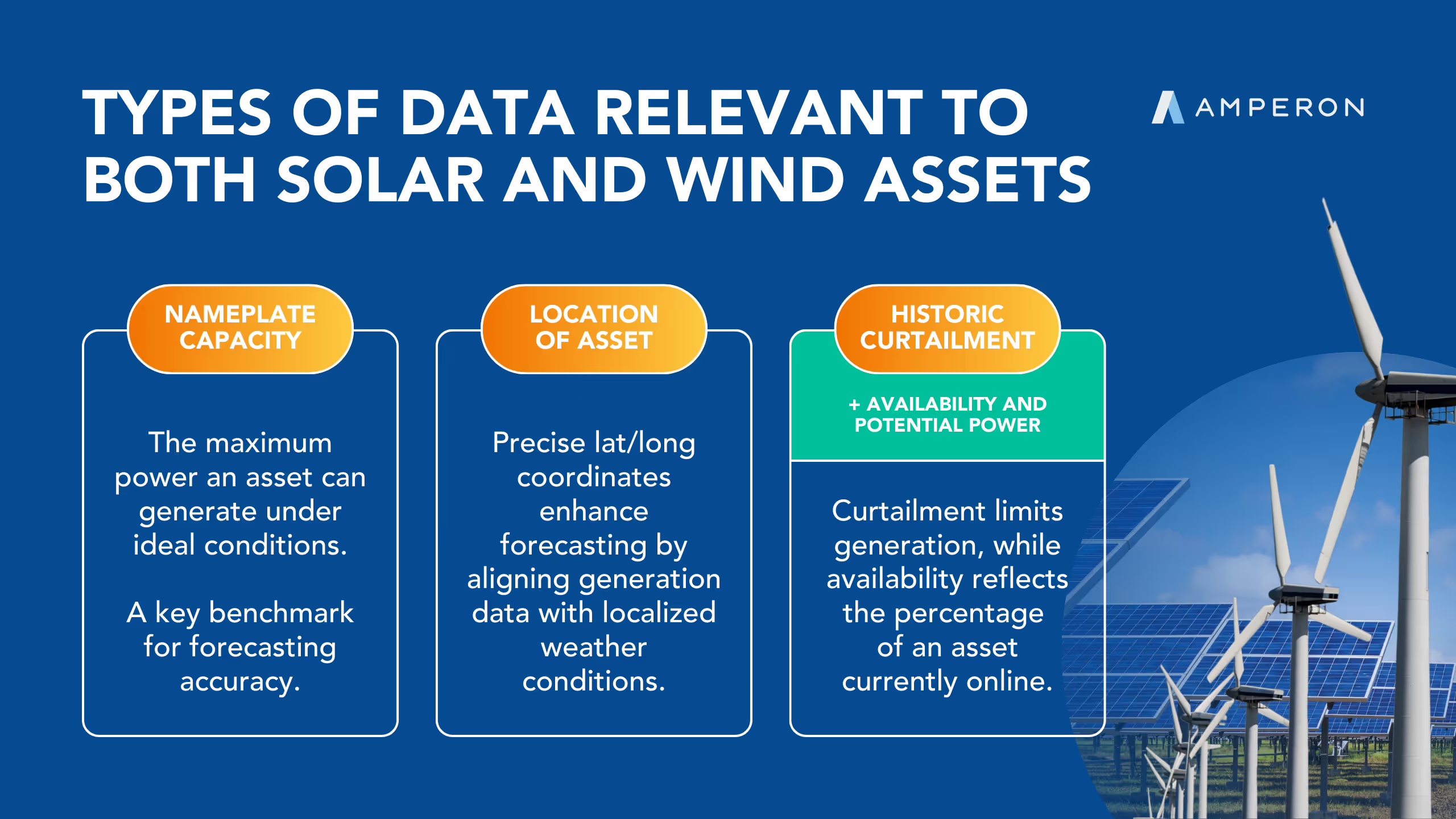
2. Integrating Historical Asset Availability and Curtailment Data
Power generation forecasting has to separate two very different causes of low output: weather and curtailment. Weather sets the physical ceiling on what an asset can produce. Curtailment is an external cutback, typically ordered by a utility, a grid operator, or a scheduled maintenance window. A model that can't tell the two apart reads a curtailment event as a forecasting miss, and its accuracy erodes over time as a result.
Amperon fixes this by letting customers upload three data sources for solar and wind power forecasting: historical curtailment events, potential power output, and plant availability. Its machine learning models use this data to correctly attribute each low-output period to weather or to curtailment, learning distinct patterns for each. That distinction drives measurably better precision across Amperon's short-term and sub-hourly forecasting horizons for solar and wind power generation.
Better curtailment visibility pays off in bidding and scheduling, too. Knowing a curtailment order is likely in a given hour lets a trader adjust position before the market closes, instead of reacting after the fact.
3. Incorporating Physical Asset Attributes
Solar and wind forecasting traditionally rely heavily on physics-based models, which estimate generation output based on physical characteristics (e.g., panel orientation, efficiency, turbine height). While useful, these models have inherent limitations, especially when dealing with limited historical data. Amperon has enhanced our renewable forecasts by incorporating physical asset attributes into our ML models. This hybrid approach combines the benefits of physics-based modeling with the accuracy of ML-driven predictions. It improves forecast precision, particularly for assets with limited historical generation data. This feature is available in both our solar and wind short-term and sub-hourly forecast.
.avif)
Mitigating Risk on Renewable Assets with Accurate Generation Forecasts
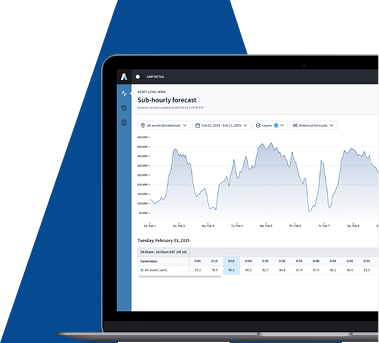
Amperon’s wind and solar generation forecasts deliver hourly updates up to 15 days and unparalleled granularity of up to 5-minute intervals, empowering utilities and IPPs to maximize financial efficiency and operational reliability.
With unmatched accuracy and granularity, Amperon customers avoid these common issues:
- Financial losses: Inaccurate predictions affect bidding strategies in energy markets, leading to lost revenue opportunities.
- Over- or under-hedging: Poor visibility into future generation can lead to suboptimal hedge positions, increasing exposure to market volatility.
- Inefficient asset utilization: Without precise forecasts, operators risk under-deploying assets during high-value intervals or overcommitting during periods of low generation.
- Costly real-time corrections: Errors in generation forecasting force market participants to make last-minute purchases in expensive real-time markets to meet demand or compliance obligations.
- Grid instability risks: For utilities managing both generation and load, inaccurate forecasts can contribute to imbalances that strain the grid or trigger unnecessary curtailment.
Out with the old...
Selecting the right evaluation metrics for solar and wind power forecasting means retiring most of the tools built for conventional generation. Renewables generation forecasting simply behaves differently, and three of the standbys don't hold up:
MAPE divides error by actual output. That breaks down whenever output is near zero — overnight, for solar — producing error values that are either wildly inflated or undefined.
nMAE divides mean absolute error by average output over a set period. One low-output stretch, a cloudy winter month, skews the average and makes a strong forecast look worse than it is.
RMSE reports error in raw energy units, megawatt-hours, with no adjustment for asset size. A 5-megawatt farm and a 500-megawatt farm simply aren't comparable on that basis.
None of the three account for scale. cnMAE avoids all three failure modes by normalizing to rated capacity instead of output. The metric stays stable across asset sizes and across time periods, which is why Amperon uses it as the standard.
Dive deeper with our cnMAE Whitepaper.
.avif)

.svg)





































%20(3).png)
%20(2).png)
%20(1).png)






.png)


.avif)



.avif)

.avif)

.avif)
%20(15).avif)
.avif)


.avif)

.avif)
.avif)