Product Launch
New Product Alert! Probabilistic Asset Solar and Wind Short-Term Forecasts
Learn More
Renewable Asset Forecasting

Renewable Generation Forecasting Software for Solar & Wind Assets

What is renewable generation forecasting?

Renewable generation forecasting, also called renewable energy forecasting or renewable asset forecasting, predicts how much electricity solar and wind assets will generate over a given time period (typically hourly or sub-hourly up to two weeks out). Renewable generation forecasts are impacted by weather and by a number of asset-specific parameters.

Unlike grid-level net demand forecasting, which predicts total consumption minus total renewable generation across an entire market, renewable asset forecasting software predicts the output of individual generation assets using solar irradiance data, wind speed at hub height, and asset metadata such as panel tilt and azimuth for solar farms and power curves for wind farms.

10+ GW

Wind and solar generation forecasted

250+

Wind and solar assets forecasted

Worldwide

Availability

Features
Legacy Asset Forecasts
Amperon
Modeling methodology
Reliant on physics-only models
Hybrid physics-based and machine learning
Weather ensembling
Limited
Dynamic multi-vendor blending
Update frequency
Varies, up to every 6 hours
Hourly
Ramp detection
Limited
Real-time with sub-hourly resolution
Onboarding time
Months
Weeks
Probabilistic forecasting
Varies
Yes

How Amperon compares to legacy renewable energy forecasting software

Many legacy renewable generation forecasts rely on physics-only models and take months to deploy. Amperon’s approach is structurally different.

Forecast any asset, anywhere

Our renewable power forecasting models are trained on your site’s data and local weather, not on grid-level data. If you have coordinates and generation history, we can forecast it.
250+

Wind and solar assets forecasted worldwide

Amperon's renewable asset forecasting products
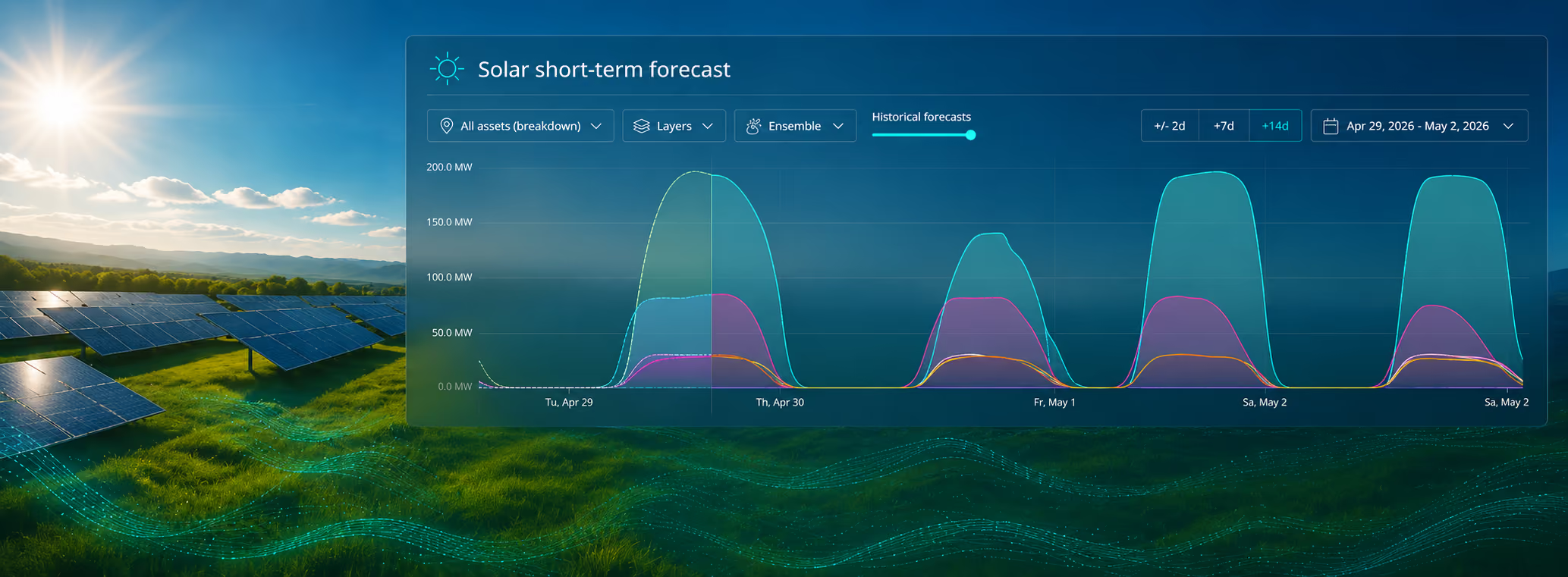
Solar panels on a landscape overlaid with Forecasting data line graphs

Solar forecasts

Asset-level solar generation forecasts from sub-hourly through two weeks out. Each model is trained on your specific site’s irradiance history, panel configuration (capacity, tilt, azimuth, tracking), inverter specs, and hyper-local weather patterns. Probabilistic solar forecasting enables risk-aware bidding.
  • Solar asset short-term forecast
  • Solar asset sub-hourly forecast
Explore
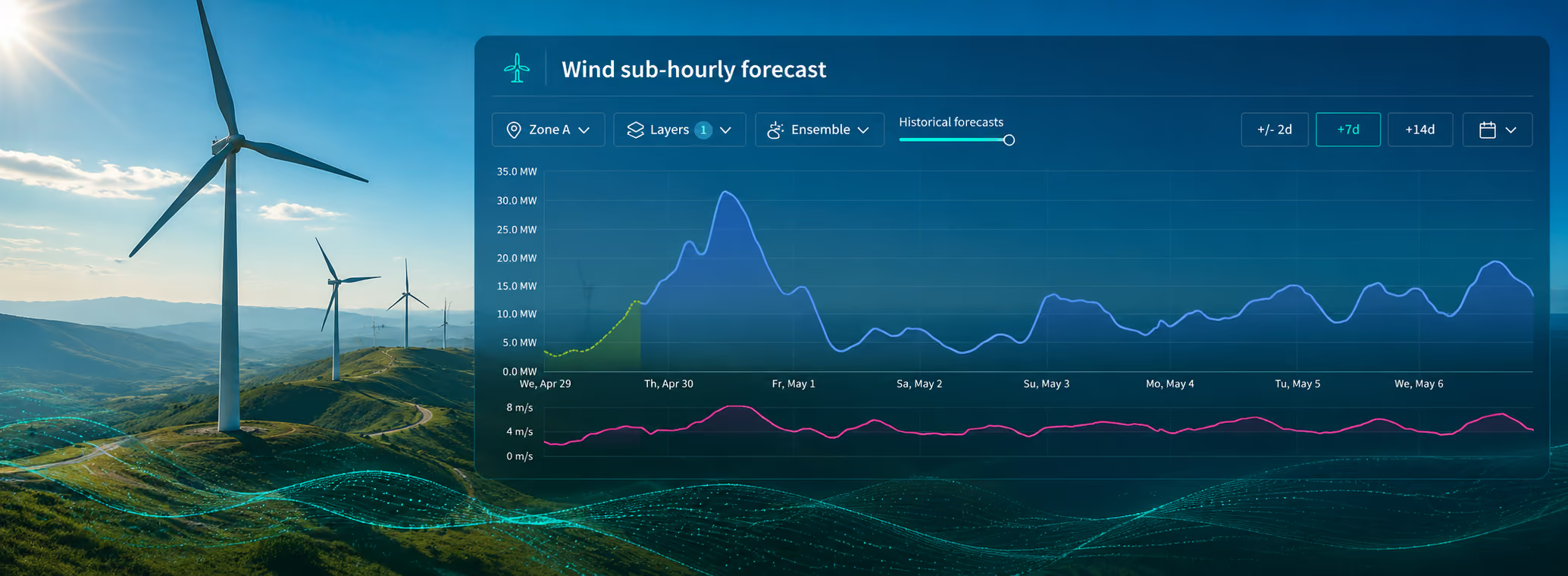
wind turbines on a landscape with forecasting data overlaid as a line graph

Wind forecasts

Asset-level wind generation forecasts from sub-hourly through two weeks out. Each model is trained on your wind farm’s power curve, hub height, terrain exposure, and site-specific wind patterns that regional weather models miss. Probabilistic wind forecasting enables risk-aware bidding.
  • Wind asset short-term forecast
  • Wind asset sub-hourly forecast
Explore

Who uses renewable asset forecasting software

Solar panels and wind turbines on a landscape for IPPs

Independent Power Producers

Generation scheduling, curtailment management, and portfolio reporting for your solar and wind fleet.
Solar STF
Wind STF
Solar Sub-hourly STF
Wind Sub-hourly STF
Utility professionals viewing power lines

Utilities

Renewable generation outlook for intelligent supply stack procurement decisions.
Solar STF
Wind STF
Grid Net Demand STF
Power trader analyzing forecasting data

Traders

Site-level generation signals for day-ahead and intra-day market participation.
Solar STF
Wind STF
Solar Sub-hourly STF
Wind Sub-hourly STF

Delivery & integration

UI
API
File Export
Snowflake

Get your forecasts however your team works. Amperon delivers enterprise-grade data security and reliability through our platform, our REST API, flat file exports, or our Snowflake integration.

View integration documentation

Renewable forecasting FAQs

Here are some answers about our platform, implementation process and pricing.
Amperon builds asset-specific generation forecast models that combine physics-based representations of each asset's performance characteristics with machine learning trained on historical generation and weather data. 

Models retrain hourly on the latest observational inputs, producing sub-hourly forecasts that reflect current atmospheric conditions rather than static assumptions. Probabilistic outputs quantify the range of likely generation outcomes across weather scenarios, giving operators visibility into forecast uncertainty at the time horizons that matter most for bidding and scheduling decisions. Read about how we are helping Independent Power Producers like Terra-Gen accurately schedule their assets into the day-ahead market.
We target 4-6% cnMAE for solar forecasts and 7-15% cnMAE for wind forecasts. Actual results vary by location. For more on the cnMAE accuracy metric, see cnMAE: The Right Metric for Evaluating Solar and Wind Forecasts.

Capacity-normalized Mean Absolute Error, or cnMAE, measures forecast error as a percentage of an asset's installed capacity rather than its actual generation output. This distinction matters because renewable generation frequently operates at low output levels, particularly during morning and evening hours for solar, and expressing error as a percentage of actual output during those periods can make forecast performance appear far worse than it functionally is. 

cnMAE provides a stable, asset-scale denominator that allows meaningful accuracy comparisons across assets, seasons, and time horizons, making it the most reliable basis for evaluating and benchmarking renewable generation forecast quality. For more on the cnMAE accuracy metric, see cnMAE: The Right Metric for Evaluating Solar and Wind Forecasts.

Rather than producing a single forecast that may perform poorly under unusual atmospheric conditions, Amperon’s probabilistic solar and wind generation forecasts quantify the range of likely generation outcomes across weather scenarios along with the real-world likelihood of each scenario, giving operators a calibrated view of tail risk. For more, see Quantifying Solar and Wind Uncertainty with Probabilistic Forecasting.
Amperon uses a dynamic blend of multiple leading weather models from vendors such as ECMWF, DTN, AG2, and DWD, depending on the region. Learn more about Amperon’s approach to weather ensembling here.
Amperon’s renewable energy forecasts update hourly, which continuously takes into account changing weather and generation dynamics and helps to capture crucial ramping periods that 6-hour updates miss. Hourly updates refer to model retraining, meaning new sub-hourly renewable output predictions are available every hour.
Yes, Amperon’s solar and wind forecasts provide predictions at hourly or sub-hourly granularity, up to every 5 minutes, which is more than enough to forecast output during morning and evening ramps, peak pricing periods, and coincident peak events.
Amperon works collaboratively with asset operators to identify and collect relevant data streams. If all needed data is readily available, Amperon can stand up wind and solar forecasts in a matter of days. Typically, it takes a few weeks to collect and integrate data streams and deploy and test a solar or wind forecast.
Probabilistic wind and solar forecasting takes the guesswork out of renewable energy bidding by quantifying not only the range of possible outcomes, but the associated likelihood of each scenario. This helps asset operators calibrate expectations against real-world probabilities and compare scenarios against each other. For example, a P50 forecast is the median, the actual value is equally likely to come in above or below it. Whereas a P90 is a conservative estimate with the actual expected to land at or below it 90% of the time, making it useful for downside planning. For more, see Quantifying Solar and Wind Uncertainty with Probabilistic Asset Forecasting.

Get more from every megawatt

See how asset-level forecasting can reduce curtailment, tighten bids, and increase revenue from your solar and wind portfolio — with a demo built around your actual assets and markets.